Learning to Drive in Ontario: A Beginner’s Step-by-Step Guide
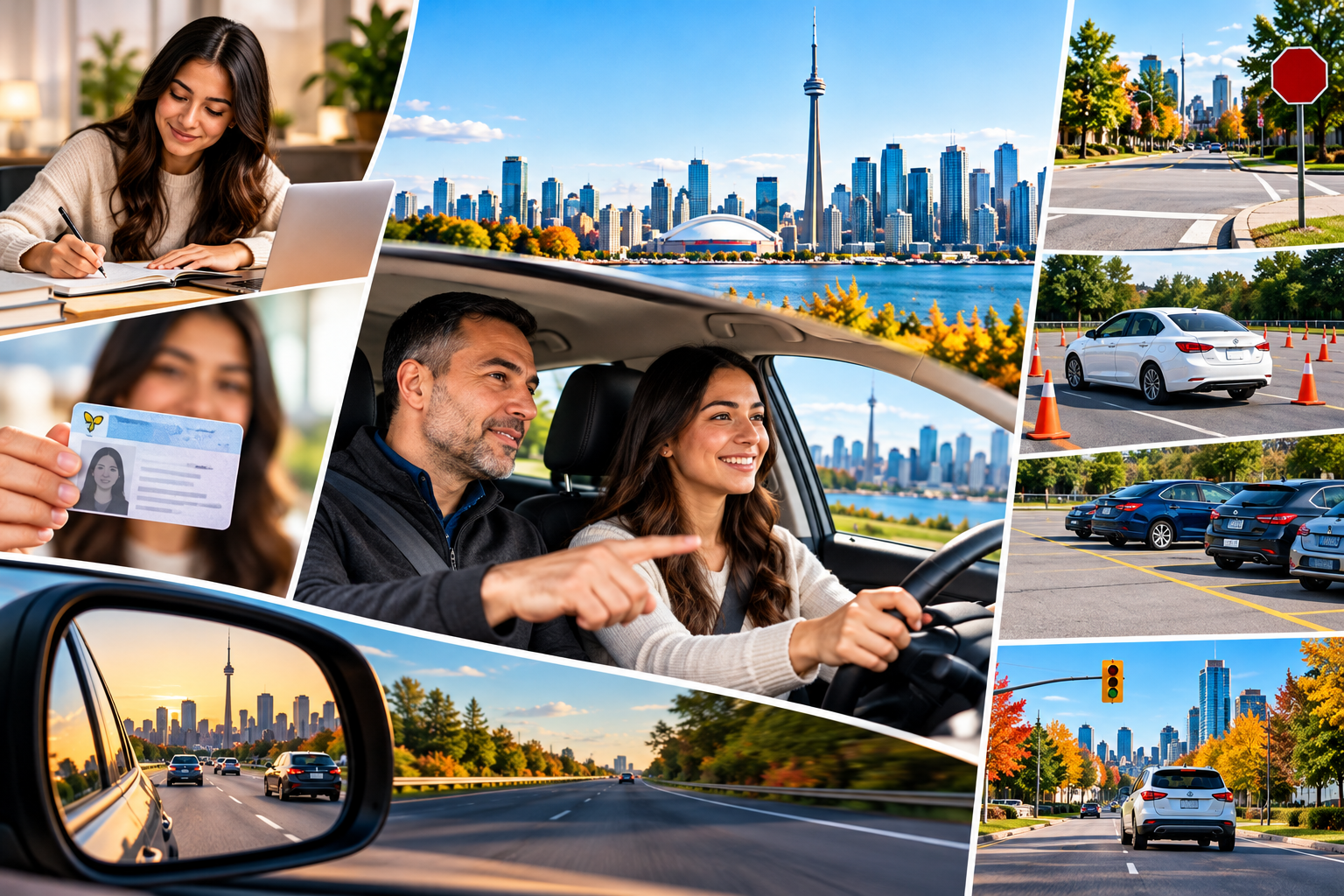
There are two journeys happening when you learn how to drive, and most guides only cover one.
The first is paperwork tests, waiting periods, licence levels. The second is skill: actually being able to control a car, read traffic and make decisions without thinking about them.
This guide is about the second one. For the licensing side, our guide to Ontario’s graduated licensing system covers the stages and timelines in full.
The Steps at a Glance
| Step | What it involves |
| 1. Get your G1 | Vision test and knowledge test — the paperwork that lets you start |
| 2. Decide how you will learn | Driving school, a supervising driver, or both |
| 3. First time behind the wheel | Controls, feel, very low speed |
| 4. Build skills in order | From basic control to busy intersections |
| 5. Practise between lessons | Where most of the real learning happens |
| 6. Prepare for your G2 test | Polish the specific manoeuvres |
| 7. Keep learning toward your G | Highways, and everything you have not met yet |
Step 1: Get Your G1
You cannot practise legally without it. You need to be at least 16, be an Ontario resident, and pass a vision test and a knowledge test on road rules and traffic signs. Once you hold a G1 you are a student driver, and everything below becomes available to you.
The knowledge test is studied, not driven it comes from the Official MTO Driver’s Handbook. Our G1 test study guide covers how to prepare.
Studying for the G1 is not wasted time before the “real” learning starts. Knowing right-of-way rules before you are sitting in traffic means you are only learning one thing at a time.
Step 2: Decide How You Will Learn
You have three realistic options, and most people end up with the third.
| Option | Strengths | Limits |
| Driving school only | Structured, professional feedback, dual-control car | Fewer total hours unless you book a lot |
| Supervising driver only | Lots of hours, flexible, no lesson cost | Habits go uncorrected; your supervisor may not know current standards |
| Both | Lessons set the standard, practice builds the hours | Needs a bit of coordination |
If you use a supervising driver, Ontario requires them to hold a full licence with at least four years of driving experience, have a blood alcohol level below .05 (zero if they are 21 or under), and be the only other person in the front seat.
What about a government-approved course?
A Beginner Driver Education (BDE) course is 40 hours in total — 20 hours of classroom instruction, 10 hours of in-vehicle training with a licensed instructor, and 10 hours of flexible instruction time. Completing an approved course lets you take your first road test after 8 months instead of 12.
If you are weighing up an online classroom, online vs in-car driver training explains what each part actually covers.
Whichever route you choose, check the school appears on the ministry’s list of approved driving schools. Only approved schools can certify you, and only certification shortens the wait.
Step 3: Your First Time Behind the Wheel
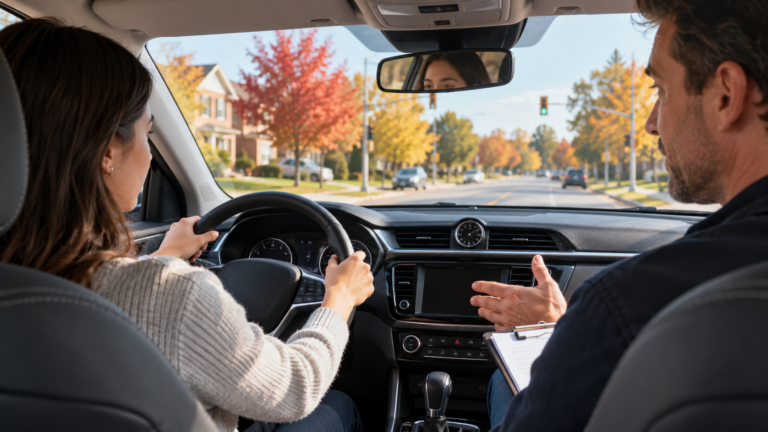
Almost nobody drives on a road in their first session, and you should be suspicious of anyone who starts you there. A first lesson normally begins with the car stationary while you set up the seat, mirrors and steering position, then moves to walking pace somewhere quiet.
We walk through the whole thing what to bring, what you will and will not do, and what to do if the nerves get the better of you in what to expect on your first driving lesson.
Step 4: Build Skills in Order
This is where a lot of self-taught learners go wrong — not because they practise too little, but because they practise things in the wrong order, and build nervousness instead of competence.
A reasonable progression:
| Stage | What you work on |
| Basic control | Starting, stopping, steering, speed control, gentle turns |
| Quiet streets | Lane position, signalling, stop signs, low-speed turns |
| Observation habits | Mirrors, shoulder checks, scanning ahead — before traffic gets busy |
| Busier roads | Lane changes, judging gaps, traffic lights, multi-lane turns |
| Manoeuvres | Parking, reversing, three-point turns |
| Complex traffic | Busy intersections, pedestrians and cyclists, unfamiliar routes |
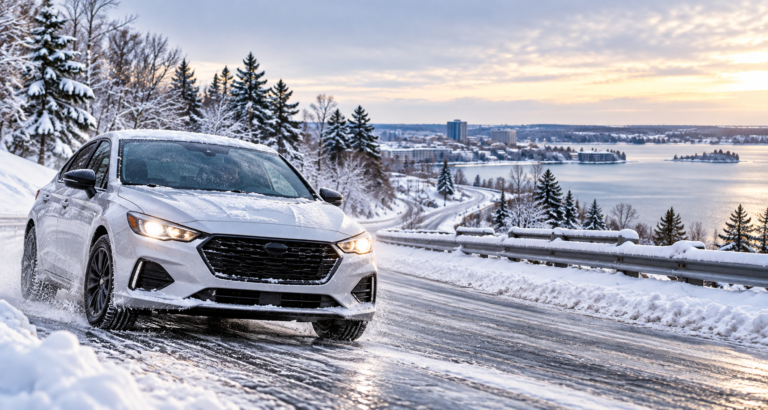
| Conditions | Rain, dusk, night — and in this region, winter |
The observation habits belong early, not late. Checking mirrors every five seconds or so, and shoulder checking blind spots, are far easier to build on a quiet street than to retrofit once you are concentrating on traffic. They are also what examiners watch most closely.
The thinking behind those habits is covered in what defensive driving actually means worth reading early rather than just before your test.
Step 5: Practise Between Lessons
Lessons set the standard. Practice builds the hours. Neither works well alone. Most people who learn how to drive quickly are simply the ones doing both.
- Practise the thing you just learned, while the correction from your driving lessons is still fresh.
- Go at quiet times at first early Sunday morning is a different road from Friday at five.
- Change routes deliberately. A learner who only drives one familiar loop is memorising, not learning.
- Narrate what you see “brake lights ahead”, “cyclist on the right”. It forces the scanning habit and lets your supervisor hear what you are missing.
- Stop when you are tired. Twenty focused minutes beats an hour of drifting attention.
Remember the G1 conditions while you practise: no driving between midnight and 5 a.m., and no 400-series highways or high-speed expressways unless you are with an Ontario-certified driving instructor.
Step 6: Prepare for Your G2 Test
The G2 road test checks specific things. Ontario lists them: turning, stopping, parallel parking, driving on one-way streets, changing lanes, three-point turns, driving through residential areas, and dealing with traffic lights, stop signs and yield signs.
Two manoeuvres cause most of the anxiety, and both are entirely learnable:
Our G2 road test guide covers what the examiner is assessing and what to bring.
Step 7: Keep Learning Toward Your G
Passing the G2 is the point where many people stop learning, which is a mistake — the G test adds highway driving, and a year of habits forms in between.
Your G road test comes at least 12 months later and includes a highway component. It is worth getting comfortable on highways well before then, not in the month before the test.
Bear in mind that holding a G2 does not end the stricter rules. Our guide to what novice driver status means explains what still applies.
How Long Does It Actually Take?
This is the most-asked question and the one with the least honest answer available, so here is a straight one.
The only officially fixed number is the BDE course requirement: 10 hours of in-vehicle training with a licensed instructor. Ontario does not mandate a minimum number of practice hours beyond that. Anyone quoting you a specific total is giving you their opinion, not a rule.
What genuinely varies it:
- How often you practise. Two short sessions a week beats one long one a month, by a wide margin.
- Whether you get corrected. Unsupervised repetition of a bad habit makes it harder to fix, not easier.
- How varied your practice is. Different roads, times and conditions.
- Your starting point. Some people are comfortable with the controls in an hour; others need several. Neither predicts how good a driver you end up being.
The timeline that is fixed is the licensing one: 12 months at G1, or 8 with an approved course, then 12 months at G2.
Choosing a Driving Instructor
The instructor matters more than the school’s advertising. Worth asking:
- Are you MTO approved, and are your instructors licensed?
- Do your cars have dual controls?
- Will I have the same instructor throughout? Continuity matters more than people expect.
- How do you give feedback? You want specifics, not “that was fine”.
- Can you teach in the areas I will be driving and testing in?
Ontario names three warning signs of a bad driving school: offers of a “guaranteed licence” or to “pass without a road test”, vehicles not properly equipped with a dual brake, and insistence on cash-only payments without a receipt. Any of the three is a reason to walk away.
If You Are Nervous About Driving
Being nervous is ordinary, and it is not a sign you will be a bad driver. Often the opposite — nervous learners tend to be careful ones.
- Start somewhere with nothing to hit. An empty car park removes most of the fear at once.
- Shorten the sessions. Confidence is built by finishing calmly, not by enduring an hour.
- Name the specific fear. “Driving” is unmanageable; “merging” is a thing you can practise on purpose.
- Tell your instructor. A good one will change the lesson plan rather than push you through it.
Common Beginner Mistakes
- Practising only where it is easy. Comfortable repetition stops teaching you anything fairly quickly.
- Leaving observation habits until test preparation. They should be automatic long before then.
- Learning the test instead of learning to drive. Examiners notice, and so does the first unfamiliar road you meet afterwards.
- Not clearing the whole car in winter. Lights, plates and roof — not just a porthole in the windscreen.
- Treating the G2 as the finish line. It is the halfway point.
Conclusion
Go Drive Driving School is MTO approved and teaches beginner driving lessons across Barrie, Innisfil, Bradford, Midhurst, Springwater, Orillia, Alliston, Cookstown and Angus one-on-one, with licensed instructors. See our programs and fees or contact us at 705-717-0406.
Learning through a Simcoe County winter? Winter driving tips for Barrie and area covers what changes when the weather does.
FAQs
How can I learn to drive in Ontario?
Get your G1 first, then learn through a driving school, a qualified supervising driver, or both. Build skills in order — control, then quiet streets, then observation, then traffic and practise between lessons.
How many driving lessons do I need?
There is no official number. An approved BDE course includes 10 hours of in-vehicle training; beyond that it depends on how often you practise and how varied that practice is.
Can I learn to drive without a driving school?
Yes, with a supervising driver who holds a full licence with at least four years of experience. But you will not get the 8-months-instead-of-12 benefit, which requires a government-approved course.
What happens on your first driving lesson?
Usually controls, seat and mirror adjustment, then very low-speed driving in a quiet area. Most instructors do not start you on a busy road.
How old do you have to be to learn to drive in Ontario?
You can get a G1 at 16, and you need a G1 before you can practise.
Can I practise on the highway with a G1?
Not on 400-series highways or high-speed expressways — unless you are accompanied by an Ontario-certified driving instructor.
Is it harder to learn to drive as an adult?
Not inherently. Adults often learn the rules faster and worry more about mistakes. The practice requirement is much the same.
What should I learn first?
Basic car control at very low speed, somewhere with no traffic. Everything else is built on being able to steer, stop and judge speed without thinking about it.