
G Full Road Test Ontario: What Tested & How to Prepare
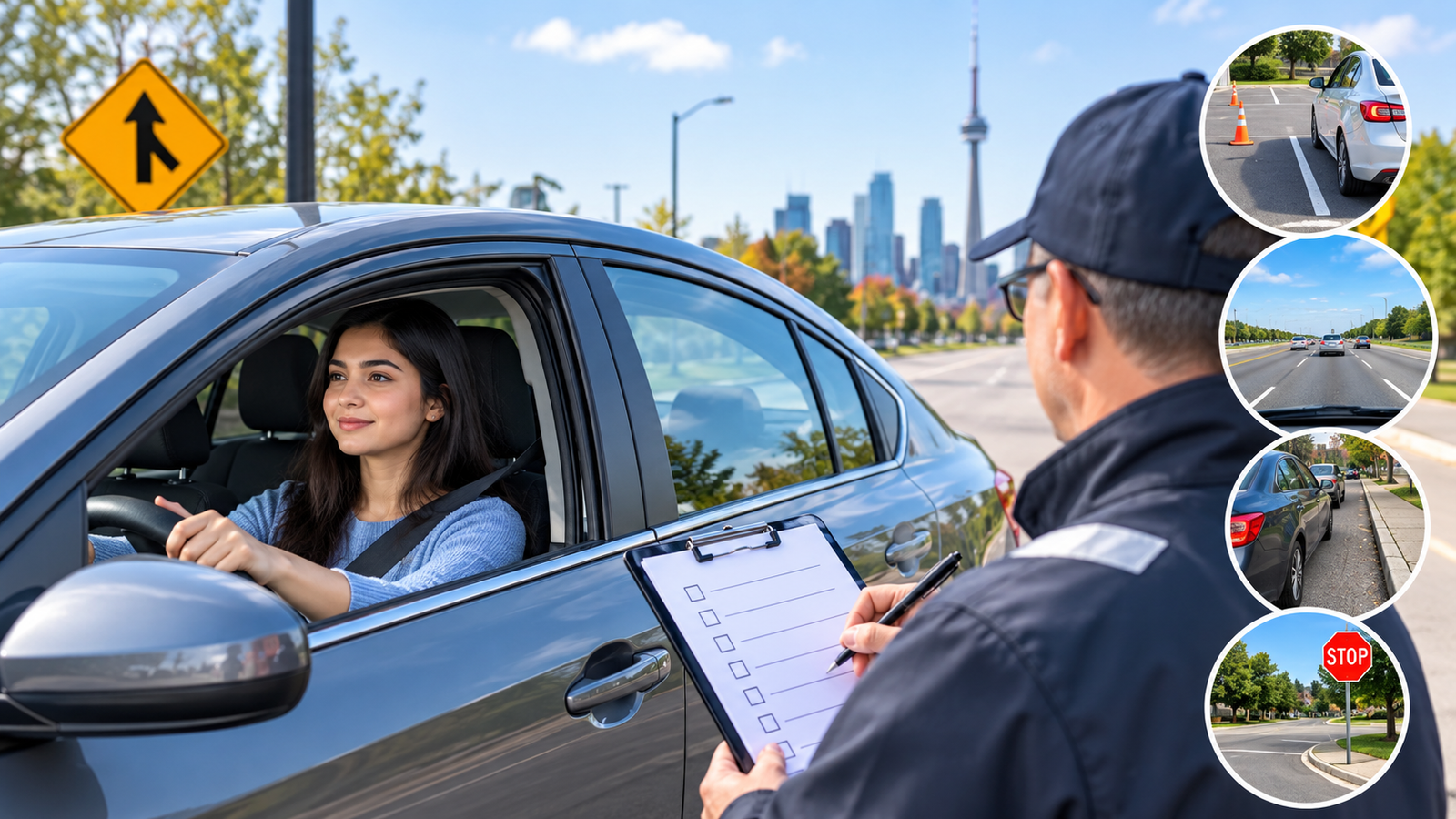
The G full road test is the last step in Ontario’s graduated licensing system. Pass it and every novice restriction lifts: no more zero blood alcohol rule, no more passenger limits, just a full G licence.
It is also a different test from your G2. The G test is built around highway driving, and there is one requirement that catches people out before they even reach the car. This guide covers all of it.
G Full Road Test: Quick Facts
| Question | Answer |
| Official names | G road test, G2 exit test, Level Two road test |
| When can I take it? | After 12 months with a G2 licence |
| How long is the test? | Usually about 30 minutes of driving |
| Main focus | Highway and major road driving, including merging |
| Special requirement | You must declare your recent highway driving experience |
| Do they give me a car? | No. You bring your own, a borrowed or a rented vehicle |
| Where | A DriveTest centre or a part-time Travel Point location |
| After you pass | A full Class G licence with no novice restrictions |
What Is the G Road Test?
Ontario’s graduated licensing system has two learning levels and two road tests. The G2 road test moves you out of G1. The G road test is the second one, and passing it gives you a full Class G licence.
You may also hear it called the G2 exit test, the Level Two road test, or simply the full G road test. They all mean the same exam, and a driver examiner scores it the same way.
If you have not passed your G2 yet, start with our G2 road test guide instead.
When Can You Take the G Road Test?
You can take the test after 12 months with a G2 licence. Unlike the G1 stage, there is no driver-education shortcut here — the 12 months at G2 is a full 12 months regardless of what courses you take.
Keep an eye on your dates. You have up to five years to finish the whole graduated licensing process from your G1. If you are approaching five years without a full G, DriveTest explains that you may requalify as a G2 driver for another five years by passing the G2 road test again, with road test and licensing fees applying.
What Is the Highway Driving Experience Declaration?
This is the requirement that surprises people, and it is worth reading twice.
If you are taking the G road test, you must declare your driving experience to show you have spent enough time on highways. You will be asked how many times in the last three months you have driven on a highway with a speed limit of at least 80 km/h, or on a 400-series highway.
To qualify, you must have driven at least five times on those roads in the last three months. You also have to indicate the average length of those trips: under 5 km, between 5 and 15 km, or over 15 km.
If you do not have the required highway experience, your appointment will be cancelled and you will lose 50% of your road test fee. Plan your highway practice months before you book, not the week before.
Which roads count?
The 400-series highways DriveTest names are:
- Highways 400, 401, 402, 403, 404, 405, 406, 407, 409, 410, 416, 417, 420 and 427
- The Queen Elizabeth Way (QEW)
- The Don Valley Parkway (DVP)
- The Gardiner Expressway
- The E. C. Row Expressway
- The Conestoga Parkway
Any highway with a speed limit of at least 80 km/h also counts. For drivers in the Barrie area, Highway 400 is the obvious one, and it is worth building up real trips on it rather than one nervous drive to tick a box.
What Is Tested on the G Road Test?
The handbook lists the tasks the driver examiner scores. On the standard G road test these include:
- Left and right turns — the approach, the turn itself and the completion
- Stop intersections
- Uncontrolled intersections
- Lane changes
- Freeway entry, freeway driving and freeway exit
- Curves
- Driving in business sections
- Parallel parking
- Three-point turns
The examiner gives you directions and scores whether you carry out each task safely and correctly.
What Changed About the G Road Test?
Here is where a lot of online advice is out of date.
Until further notice, the G road test has been temporarily modified at full-time DriveTest Centres. The modified test does not include these elements, because they are already covered on the G2 road test:
- Parallel parking
- Roadside stops
- Three-point turns
- Driving in residential neighbourhoods
It still includes all the fundamental elements:
- Driving on major roads and expressways, including merging on and off, maintaining appropriate speed and space, and signalling
- Turns, curves and lane changes
- Intersections
- Driving in business areas
Part-time Travel Point locations continue to offer the standard G road test. So whether you face parallel parking and a three-point turn depends on where you book. Confirm with DriveTest before your test, and if in doubt, practise them anyway.
Not sure how the two tests differ? Read G2 vs G road test
How Do You Prepare for the Highway Section?
Highway driving is the heart of the G test, and it is where G2 drivers have the least practice. The handbook breaks it into three parts.
Entering the freeway
Use the acceleration lane properly. Signal and increase your speed to merge smoothly with traffic, assessing the traffic as you go to see where you will move into the nearest freeway lane.
The commonest mistake is treating the acceleration lane like a queue arriving at the end of it too slowly and then trying to squeeze in. Get up to the speed of traffic while you still have lane left.
Driving along the freeway
- Keep a steady speed, looking forward and anticipating what is going to happen on the road ahead.
- Keep your vision moving — scan the road ahead, to each side and behind.
- Look ahead 15 to 20 seconds, or as far ahead as you can see.
- Traffic should keep to the right, using the left lanes for passing.
- Leave space around your vehicle so you can see clearly in every direction and have time and space to react.
Leaving the freeway
Move into the deceleration lane first. Do not slow down before you get there. Once you are in it, reduce your speed gradually to the speed shown for the exit ramp.
Watch for what the handbook calls speed adaptation, or velocitization. After a stretch at highway speed you may not realize how fast you are going. Check your speedometer on the ramp rather than trusting how it feels — this is one of the most common ways G test candidates lose marks.
What Should You Bring to the G Road Test?
The same items DriveTest asks for at any road test:
- A vehicle in good working order
- Your current driver’s licence
- A printout of your road test confirmation email
- Glasses or contact lenses, if you need them to drive
- Enough gas in the vehicle to complete the test
- Money for test fees, only if you are hoping for a standby appointment
Arrive at least 30 minutes early to check in. The vehicle check is identical to the G2 test, so run through our G2 road test checklist before you go every requirement on it applies here too. For current prices, see the DriveTest fees page
What Are the Most Common G Road Test Mistakes?
How to pass the G test comes down to avoiding a small set of habits — the ones that creep in after a year of driving solo with nobody watching.
- Merging too slowly. Arriving at the end of the acceleration lane below the speed of traffic forces everyone else to react to you.
- Slowing down on the freeway before the exit lane instead of after entering the deceleration lane.
- Speed adaptation on the ramp. The ramp speed feels absurdly slow after the highway; check the speedometer.
- Cruising in the left lane. Keep right except to pass — this is a rule, not a preference.
- Mirror-only lane changes. A year of solo driving is exactly how the shoulder check habit fades.
- Following too closely at speed. The two-second minimum needs more room at highway speeds.
- Assuming the test is easier than the G2. It is shorter on manoeuvres but much less forgiving on judgment.
Our road test tips guide covers the observation and control habits examiners score on both tests.
Things to Remember on G Test Day
Here is what to expect on the day, and the short list worth running through the night before.
- Check your highway experience qualifies before you even keep the appointment — five trips in the last three months.
- Arrive 30 minutes early and check in inside the centre.
- Expect roughly 30 minutes of driving, with a highway section in the middle.
- Ask your questions before you start. The examiner explains the test but is not allowed to coach you during it.
- Merge at the speed of traffic, not below it.
- Keep right except to pass.
- Check your speedometer on the exit ramp, not your instincts.
- Expect a short verbal summary at the end, whichever way it goes.
What Happens After You Pass the G Test?
Once you pass, you get a full Class G licence and the novice restrictions lift. Until that moment you are still a G2 driver, which means the zero blood alcohol rule and the seatbelt-per-passenger rule still apply, along with the extra passenger conditions for drivers 19 and under.
Go back inside the centre to apply your test results. You will receive a temporary licence valid for 90 days or until your photo card arrives in the mail. If you do not apply your results within 12 months, they are no longer valid.
If you are unsuccessful, your scoresheet shows where to improve. You can take as many road tests as you need while your licence is valid, you generally have to wait at least 10 days between tests, and fees apply each time.
How Do You Book the G Road Test?
You can book, cancel or reschedule your G DriveTest appointment online, by phone at 647-776-0331 or 1-888-570-6110, or in person at any DriveTest centre. You will need your licence number and expiry date, a first, second and third choice of location, and a preferred date and time.
Cancel at least 48 hours before your appointment to avoid a cancellation fee. For the full process.
Conclusion
The G test rewards real highway experience, and that is hard to build alone if merging still makes you tense. Go Drive Driving School offers G road test preparation with one-on-one in-car lessons on real highways, including Highway 400, so merging, lane changes and exits feel routine before test day. See our programs and fees or contact us at 705-717-0406.
FAQs
What is tested on G road tests?
Turns, stop and uncontrolled intersections, lane changes, curves, business-area driving, and freeway entry, driving and exit. The standard test also includes parallel parking and a three-point turn.
How long is the G road test?
Usually about 30 minutes of driving, compared with about 20 minutes for the G2 test. Plan for longer at the centre once check-in and the debrief are included.
Does the G test include highway driving?
Yes. Highway and major road driving, including merging on and off, is the core of the G test.
Is parallel parking on the G test?
At full-time DriveTest Centres the modified G road test does not include it. Part-time Travel Point locations still offer the standard test, which does. Check where you are booked.
How much highway driving do I need before the G test?
You must have driven at least five times in the last three months on a highway with a speed limit of at least 80 km/h or on a 400-series highway, and you will be asked the average length of those trips.
What happens if I do not have enough highway experience?
Your appointment is cancelled and you lose 50% of your road test fee.
Can I take the G test in my own car?
Yes. DriveTest centres do not provide vehicles. The car can be owned, borrowed or rented, and it must meet DriveTest’s vehicle requirements.
Is the G test harder than the G2?
It is different rather than simply harder. There are fewer slow-speed manoeuvres, but the highway section demands better judgment of speed, space and timing.
Do I have to take the G test at all?
If you want a full G licence, yes. Bear in mind the five-year limit on completing the graduated licensing process.