
What Is Defensive Driving? Techniques Every New Driver Should Know
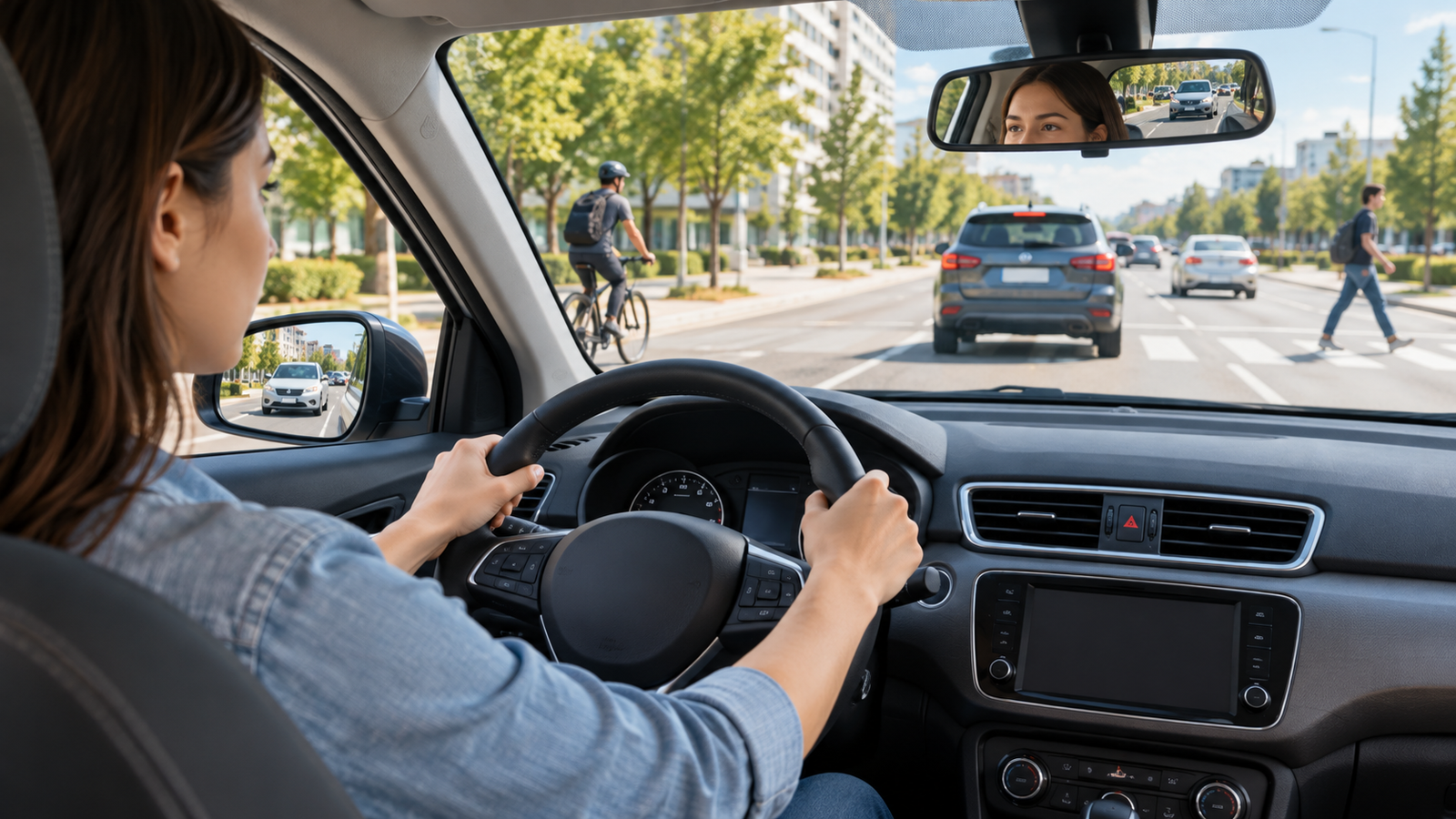
Most new drivers are taught to operate a car. Fewer are taught to read a road.
Defensive driving and safe driving describe the same skill, and it is the one that keeps you out of trouble long after the road test is behind you.
Defensive driving is the second skill. It is what separates a driver who reacts to problems from one who sees them coming and it is the difference examiners notice, long before they can explain why one candidate looks ready and another does not.
Defensive driving means anticipating what could go wrong and leaving yourself room to handle it. Not driving slowly. Not driving nervously. Driving with enough information and enough space that you are never surprised.
Defensive Driving vs Reactive Driving
The clearest way to understand safe driving is to compare the two mindsets in the same situation.
| Situation | Reactive driver | Defensive driver |
| Approaching a green light | Keeps speed, assumes it stays green | Notices it has been green a while, covers the brake |
| Car parked at the kerb ahead | Passes close at speed | Watches for a driver inside, moves over, slows |
| Truck in the next lane | Sits alongside it | Moves out of its blind spot |
| Rain starts | Keeps the same following distance | Increases the gap before it is needed |
Nothing in the right-hand column is advanced. It is the same driving, done earlier.
What Defensive Driving Is Not
Two misunderstandings are worth clearing up early, because both of them cost people road tests.
- It is not driving slowly. Driving well below the flow of traffic creates its own hazard, and examiners mark hesitation. Defensive driving is about timing and space, not speed.
- It is not hesitating. A driver who waits too long at an intersection, or refuses a safe gap, is not being careful they are being unpredictable, and other drivers cannot read them.
The defensive driver is decisive. They can be decisive because they gathered the information early.
The Core Defensive Driving Techniques
These are the habits the Official MTO Driver’s Handbook actually teaches. They are worth learning as a set, because they reinforce each other.
1. Look well ahead
The handbook advises developing “a routine for looking ahead, behind and from side to side” rather than fixing your eyes on the vehicle in front.
On the freeway, the handbook is more specific: scan the road 15 to 20 seconds ahead — roughly a quarter of a kilometre at highway speed. At that range you see brake lights several cars up, not just the bumper ahead of you.
2. Check your mirrors every five seconds
The handbook puts a number on it: “check your mirrors every five seconds or so.”
The point is not the mirrors themselves. It is that you should always know what is behind you before you need to know before you brake hard, before you change lanes, before you turn.
3. Shoulder check your blind spots
Mirrors do not show everything. The handbook is direct: “check your blind spots by turning your head to look over your shoulder.”
It also warns that large commercial vehicles “typically have large blind spots to the sides and back.” If you cannot see a truck driver’s mirrors, assume the driver cannot see you and do not sit there.
4. Keep a two-second following distance
The handbook’s rule: “a safe following distance is at least two seconds behind the vehicle in front of you.”
To measure it, pick a fixed marker at the roadside — a sign or a pole. When the vehicle ahead passes it, start counting. If your front bumper reaches the marker before you finish two seconds, you are too close.
The handbook is explicit that the two-second rule gives a minimum and applies only to ideal driving conditions. Leave more room in bad weather, when following motorcycles or large trucks, or when carrying a heavy load.
5. Hands at nine and three
“Picture the steering wheel as a clock and place your hands at nine o’clock and three o’clock.” It gives you the most control if you have to steer suddenly, and it keeps your arms clear of the airbag.
6. Leave yourself space on all sides
Following distance protects the front. Defensive drivers think about the other three sides too — not sitting in blind spots, not driving in a tight cluster of cars, and keeping an escape route in mind in slow traffic.
The habit to build: ask yourself where you would go if the car in front stopped suddenly. If the answer is “nowhere”, change something.
Adjusting for Poor Conditions
Defensive driving is mostly about recognising when the normal rules are not enough.
- Slow down in bad weather. The handbook advises driving below the posted maximum when conditions are poor, so you can stop safely.
- Turn off cruise control in “adverse driving conditions (wet, icy or slippery roads).”
- Be extra careful at dusk and dawn, when, as the handbook puts it, “everyone has difficulty adjusting to the changing light.”
- Extend your following distance before you need it, not after you feel the car slip.
Highway conditions have their own defensive habits merging, lane discipline and exits. We cover those in highway driving tips for new drivers
Why Defensive Driving Matters on Your Road Test
Examiners do not have a box marked “defensive driving”. They assess observation, judgment and space management — which is the same thing described differently.
- Observation. Shoulder checks before every lane change and turn. Mirror checks approaching intersections and before braking.
- Judgment. Gaps you accept when turning or merging. Whether you slow for a situation developing ahead.
- Space. Following distance, and how much room you leave around cyclists, parked cars and pedestrians.
A candidate who drives defensively tends to pass without doing anything dramatic. See our G2 road test guide for what is assessed, and the G road test guide for the highway component.
Common Mistakes New Drivers Make
- Watching only the car in front. It is the single most common habit, and it removes all your warning time.
- Relying on mirrors instead of shoulder checks. The blind spot is, by definition, the part the mirror does not show.
- Treating two seconds as a maximum. It is a floor, for perfect conditions.
- Staying alongside trucks. Either pass or drop back. Sitting there is the worst of both.
- Checking mirrors only when about to move. By then you are reacting, not anticipating.
How to Build the Habit
These are the safe driving tips that actually change behaviour, rather than the ones that only sound sensible on a list.
- Narrate what you see while practising with a supervising driver — “brake lights three cars up”, “cyclist on the right”. Saying it out loud forces the scanning habit.
- Count your following distance deliberately on every drive for a week, until two seconds feels normal.
- Make the shoulder check automatic by doing it every single time, including when the road is obviously empty.
- Set a mirror rhythm rather than checking randomly — every five seconds or so, as the handbook says.
- Practise in conditions you find uncomfortable, with an instructor or experienced driver beside you. Rain and dusk are where these habits matter most.
Conclusion
Defensive driving is easier to learn when someone can point out what you did not notice. Go Drive Driving School is MTO approved and teaches new drivers across Barrie, Innisfil, Bradford, Midhurst, Springwater, Orillia, Alliston, Cookstown and Angus. See our programs and fees or contact us at 705-717-0406.
New to the whole process? Start with how Ontario’s graduated licensing system works
FAQs
What is defensive driving?
Driving in a way that anticipates problems before they happen — scanning well ahead, knowing what is around you, and keeping enough space to react.
What is safe driving?
In practice the two terms describe the same thing: operating the vehicle correctly while continuously managing the space and information around you.
What is the two-second rule?
Staying at least two seconds behind the vehicle in front. Pick a roadside marker, start counting when the vehicle ahead passes it, and you should not reach it before two seconds. It is a minimum for ideal conditions.
How often should you check your mirrors?
The Official MTO Driver’s Handbook says every five seconds or so.
What is a blind spot check?
Turning your head to look over your shoulder at the area your mirrors do not cover, before changing lanes or turning.
Can defensive driving be taught, or does it come with experience?
Both. The techniques can be taught in a few lessons; the judgment develops with practice. Learning the habits early means the practice builds the right instincts rather than the wrong ones.
Do I need defensive driving for my road test?
There is no separate defensive driving test, but observation, judgment and space management are assessed throughout both Ontario road tests.