G1 Test Rules Every New Driver Should Know in 2026
Getting your G1 licence is the very first step toward driving legally in Ontario, Canada. Before you can sit behind the wheel with a supervising driver, you need to pass a written knowledge test at a DriveTest centre.
Many new drivers underestimate this step and fail on their first attempt simply because they don’t understand the G1 test rules properly.
This guide breaks down everything Canadian learner drivers need to know from the test structure to the toughest questions you’ll face so you can walk in prepared and confident. If you want a full overview of the process first, check out our complete guide to the G1 test rules in Canada.
What is the G1 Test?
The G1 test is the first stage of Ontario’s graduated licensing system, administered by the Ministry of Transportation Ontario (MTO). It’s a computer-based written exam available at any Drive Test centre across the province.
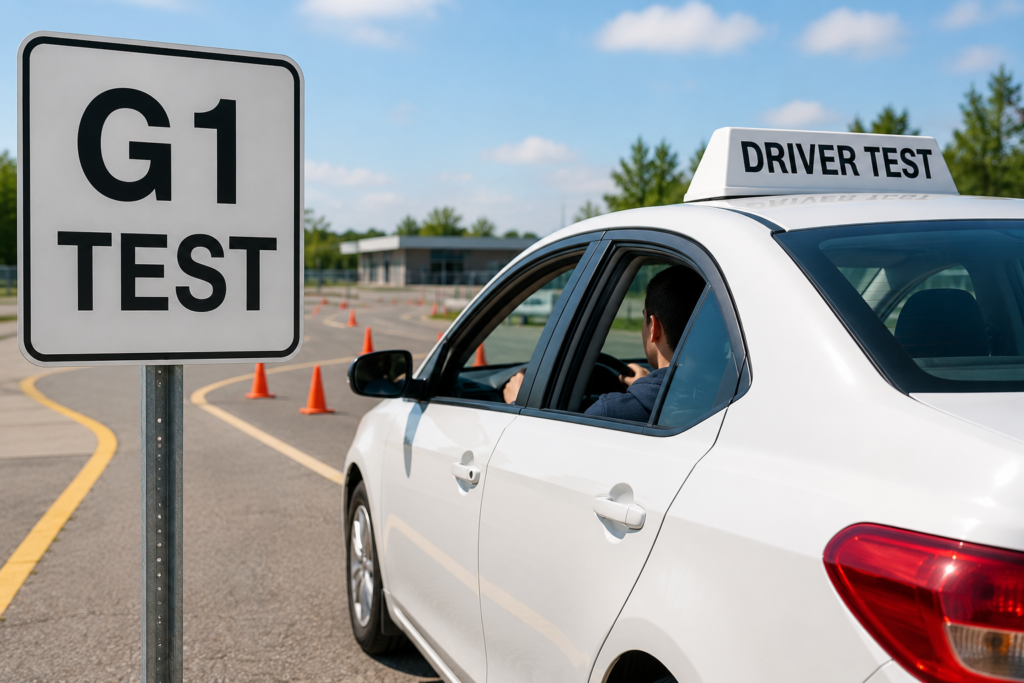
You must be at least 16 years old to book it, and you’ll need to bring valid identification along with the applicable fee. Unlike the G2 and G road tests, the G1 involves no actual driving it purely tests your knowledge of ontario g1 test rules, road signs, and safe driving practices before you’re allowed to get behind the wheel with a licensed supervisor. Not sure where your nearest centre is? We’ve listed options in our G1 test near me guide.
What Is the Format of the Ontario G1 Driving Rules Test?
The g1 driving rules test is made up of two separate sections, and you must pass both to receive your G1 licence:
- 20 questions on road signs (you need at least 16 correct, or 80%)
- 20 questions on rules of the road (you also need at least 16 correct, or 80%)
The test is available in multiple languages, including English and French, and results are shown immediately after you submit your answers.
Sections of the G1 Test Rules
- Road Signs Section — Tests your ability to recognize regulatory, warning, and information signs by shape and colour.
- Rules of the Road Section — Covers right-of-way, speed limits, safe following distances, and general traffic law.
How to Prepare G1 Rules For Practice Test
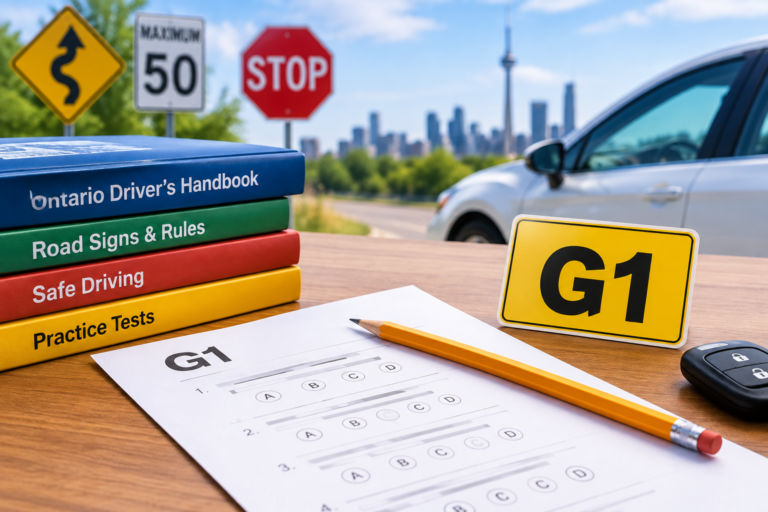
The single best resource for preparing is the official Ontario Driver’s Handbook, which covers every topic tested on exam day.
Beyond the handbook, working through a g1 practice test rules package repeatedly helps you get comfortable with question formats and timing. Many learners also enroll in a structured driving lessons program early on, since instructors often walk students through the same material covered on the written test.
Best Way to Study for G1 Test Rules
- Read the handbook cover to cover at least once before jumping into practice questions
- Use flashcards for road sign shapes and colours — this is where most people lose marks
- Take a full-length mock test under timed conditions
- Review every question you get wrong instead of just checking your score
- Avoid memorizing answers without understanding the “why” behind each rule
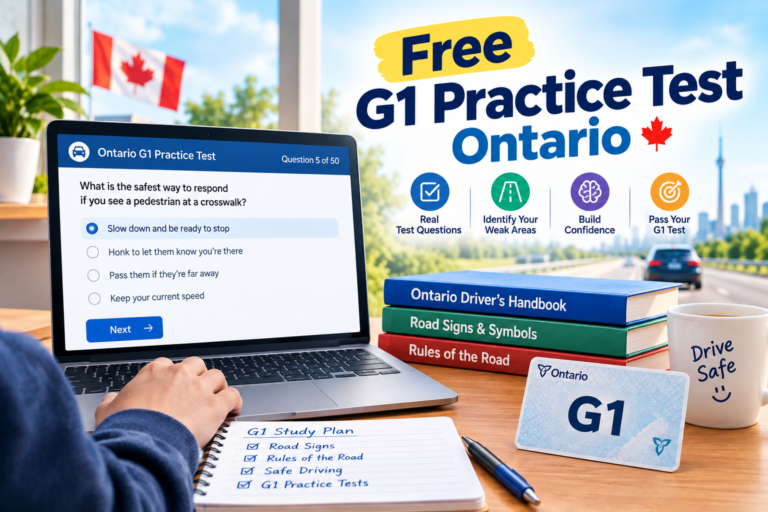
If you want a structured way to practice, try our dedicated G1 practice test Ontario tool before booking your exam date. We’ve also put together a helpful breakdown on becoming a confident G1 driver once you’ve passed and start practicing on the road.
Canada G1 Test Rules Every Beginner Must Know
This is the core of what you’re actually tested on. Here are the canada g1 test rules that come up most frequently:
- Right of way — Know who goes first at uncontrolled intersections, four-way stops, and when turning left across traffic
- Speed limits — Standard limits are 50 km/h in cities/towns unless posted otherwise, and lower in school and community safety zones
- Seatbelt laws — Every occupant must be properly secured; the driver is responsible for passengers under 16
- Zero alcohol tolerance — G1 and G2 drivers must have absolutely zero blood alcohol concentration while driving
- Distracted driving laws — Handheld device use is strictly prohibited while driving in Ontario, a growing enforcement priority covered in detail in our handheld device driving ban post
- Parking rules — Understanding no-parking zones, fire hydrant distances, and accessible parking regulations
- Traffic signals and signs — Correctly interpreting stop signs, yield signs, and pedestrian crossing signals
- Pedestrian right of way — Pedestrians always have priority at marked crosswalks and intersections
Do I Need to Know Road Rules for the G1 Test?
Yes, absolutely. The G1 test is not just about recognizing signs; half the exam is dedicated entirely to rules of the road. You cannot pass by memorizing shapes alone. A solid understanding of right-of-way, speed regulations, and safe driving behaviour is essential to reaching the required 80% passing score in that section.
What Are Some Road Rules on the G1 Test?
Some of the most commonly tested road rules include:
- Yielding to pedestrians at crosswalks
- Coming to a complete stop at stop signs, not a rolling stop
- Understanding the order of right-of-way at a four-way stop
- Stopping for school buses with flashing red lights, from both directions
- Maintaining safe following distances in various weather conditions
- Knowing when it’s legal (and illegal) to pass another vehicle
- Rules around merging onto highways
How to Pass the G1 Rules Test with Proven Tips
If you’re wondering how to pass g1 test rules on your first try, follow these proven strategies:
- Study the full handbook, not just a practice test app. Practice tests are useful for repetition, but the handbook contains explanations you won’t get from a multiple-choice app alone.
- Focus extra time on road signs. This is the section most learners struggle with, since it requires visual memory rather than logic.
- Take multiple mock tests before your real exam. Repetition builds familiarity with question phrasing.
- Book your test time strategically. Early morning slots at DriveTest centres tend to be less rushed.
- Watch out for trick questions. Some questions test subtle differences, like the distance required from a stopped school bus versus a regular stop sign.
What Rules Are Asked on the G1 Test?
The exam draws from several categories:
- Traffic laws — speed limits, passing rules, lane discipline
- Safety rules — seatbelt use, child car seats, alcohol and drug policies
- Sign recognition — regulatory, warning, and construction signs
- Situational judgment — scenario-based questions asking what you should do in a specific driving situation
What is the Hardest Part of the G1 Test Rules?
For most learners, the road signs section proves to be the hardest part of the G1 test. Unlike rules of the road, which follow logical reasoning, sign recognition relies purely on visual memory shapes, colours, and symbols that look similar but mean very different things.
Situational judgment questions can also trip people up, since they require applying multiple rules at once rather than recalling a single fact. The best way to overcome both challenges is consistent, repeated practice in the weeks leading up to your test date.
G1 Test Booking & Requirements in Ontario
To book your G1 test rules in Ontario, you’ll need:
- To be at least 16 years old
- Two pieces of identification (one showing proof of legal name and date of birth)
- The applicable testing fee, payable at the DriveTest centre
- An appointment booked in advance through the official DriveTest booking system
Once you pass, your G1 licence remains valid for five years, during which you must complete your G2 and full G licence road test, or take an approved driver education course to shorten your waiting periods between stages.
Conclusion
Passing the G1 test comes down to understanding both road signs and rules of the road — not just memorizing answers. Study the official handbook, take practice tests seriously, and pay close attention to the areas most learners find difficult, like sign recognition.
At Go Drive Driving School, we help new drivers across Ontario prepare with confidence for every stage of their licensing journey from your very first G1 knowledge test to your final G road test.
Our experienced instructors don’t just teach you how to drive; we walk you through the exact rules, road signs, and real-world scenarios that show up on your test, so you’re never guessing on exam day.
Once you’ve passed your G1, the next step is preparing for your G2 road test in Ontario, where practical driving skills come into play. Ready to get started?
Explore our full range of driving lessons and programs designed specifically for new Ontario drivers, or get in touch with Go Drive Driving School today and let us guide you from your first G1 attempt all the way to a full licence.
Frequently Asked Questions
Is the G1 test hard?
It’s manageable with proper preparation. Most learners who fail do so because they skip studying road signs thoroughly.
How many attempts are allowed for the G1 test?
There’s no strict limit, but you’ll need to pay the fee again for each retake, so it pays to prepare well the first time.
Can I drive alone after passing G1?
No. G1 drivers must always have a fully licensed supervisor (G licence, minimum 4 years experience) in the front passenger seat.
Is the G1 test only in English?
No, it’s available in multiple languages including French, at most DriveTest centres.
How long is a G1 licence valid?
Five years from the date you pass, after which you’ll need to progress to G2 or restart the process.