How to Do a Three-Point Turns on Your Road Test
A three-point turn is how you turn your vehicle around on a road too narrow to do it in one sweep. Forward, back, forward — three movements, which is where the name comes from.
It is on the G2 road test, and it is one of those manoeuvres that feels awkward until someone gives you the actual sequence. This guide gives you the method straight from the Official MTO Driver’s Handbook, plus the part most guides skip: the places where you must never attempt one.
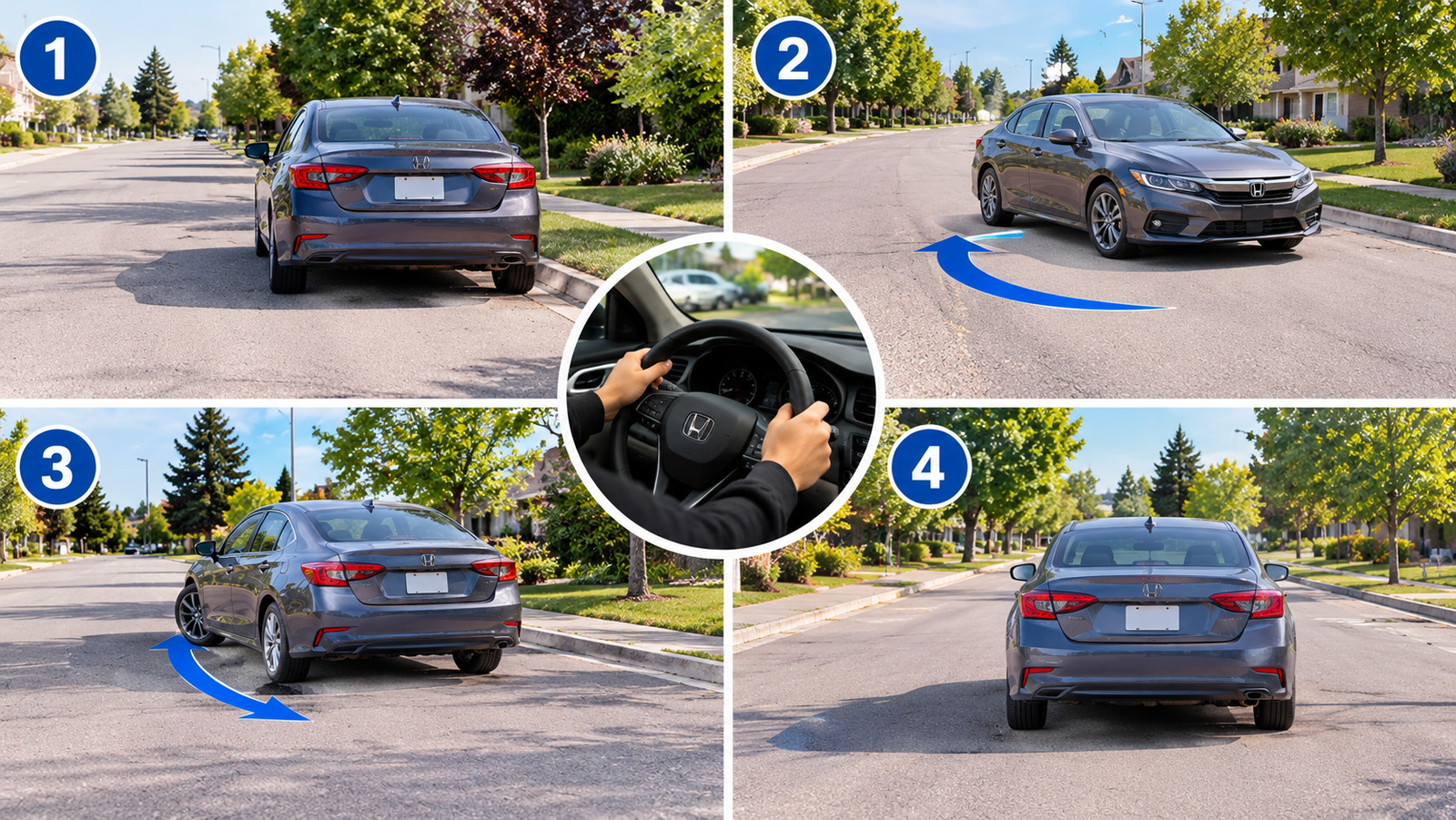
The Three-Point Turn in Three Moves
Forward to the left, reverse to the right, then forward and away — checking traffic before each move.
1
Forward to the left
When the way is clear both ways, move forward and turn the wheel sharply left toward the far curb.
Signal left first
2
Reverse to the right
Stop at the left side. Shift into reverse, check the way is still clear, then turn sharply right while backing slowly across.
Signal right first
3
Forward and away
Stop. Shift to forward gear and check traffic again. When the way is clear, drive forward.
Check traffic again
Simplified diagram for study. Steps follow the Official MTO Driver’s Handbook. Never attempt a three-point turn on a curve, hilltop, railway crossing, or near a view-blocking bridge or tunnel.
Is a Three-Point Turn on the G2 Test?
Yes. The Ontario government lists three-point turns among the basic driving skills the G2 road test checks, alongside turning, stopping, parallel parking, one-way streets, lane changes and driving in residential neighbourhoods.
DriveTest also names it directly in the skills it recommends practising before any road test: parking, reversing and three-point turns.
Does the G Test Include a Three-Point Turn?
This depends on where you take your test, and a lot of advice online is out of date on this point.
DriveTest has temporarily modified the G road test at full-time DriveTest Centres. The modified version does not include these elements, because the G2 road test already covers them:
- Three-point turns
- Parallel parking
- Roadside stops
- Driving in residential neighbourhoods
But part-time Travel Point locations continue to offer the standard G road test. So do not assume the three-point turn is gone from your G test — it depends where you book, and the change is temporary. Check DriveTest before your test date.
How Do You Do a Three-Point Turn, Step by Step?
Here is the method from the Official MTO Driver’s Handbook. Learn it in this exact order.
Before you begin
Pick your spot carefully. You need a clear view in both directions and a genuinely quiet stretch of road. Check your mirrors and your blind spots, and make sure nothing is coming.
Step 1: Forward to the left
Signal for a left turn. When the way is clear in both directions, move forward, turning the steering wheel sharply left towards the curb on the far side of the road.
Step 2: Reverse to the right
When you have reached the left side of the road, stop. Shift the vehicle into reverse. Signal a right turn. Then, after checking that the way is still clear, turn the steering wheel sharply to the right while backing up slowly to the other side of the road.
Step 3: Forward and away
Stop. Shift to forward gear and check traffic. When the way is clear, drive forward.
Notice how often the handbook repeats “check that the way is clear”. The manoeuvre has three movements and a traffic check before every one of them. That rhythm is exactly what the examiner is watching for.
Where Must You Not Do a Three-Point Turn?
This is the part most guides leave out, and it matters both on the test and in real life. The handbook is explicit:
Do not make a three-point turn on a curve in the road, on or near a railway crossing or hilltop, or near a bridge or tunnel that blocks your view.
The common thread is simple: anywhere another driver cannot see you in time. Your vehicle will be sideways across the road for several seconds with nowhere to go, so you need a long, clear line of sight in both directions before you start.
- On a curve — traffic appears with no warning
- On or near a hilltop — drivers crest the hill straight into you
- On or near a railway crossing — you could be stopped across the tracks
- Near a bridge or tunnel that blocks your view — you cannot see what is coming
Also watch for signs. If turning around is prohibited where you are, the manoeuvre is not an option regardless of how clear the road looks.
What Is the Difference Between a Three-Point Turn and a U-Turn?
Both turn you around, but they are different manoeuvres with different rules.
| Three-point turn | U-turn | |
| Movements | Forward, reverse, forward | One continuous turn |
| Used when | The road is too narrow to turn in one go | The road is wide enough |
| Visibility rule | Needs a clear view both ways | Never attempt one unless you can see at least 150 metres in both directions |
| Where it is banned | Not on a curve, railway crossing, hilltop, or near a view-blocking bridge or tunnel | Illegal on a curve, railway crossing, hilltop, or near a view-blocking bridge or tunnel |
The handbook calls a U-turn on those spots illegal, so this is not just technique advice. If you are unsure whether a U-turn is allowed where you are, the three-point turn is the safer choice — or better, drive on and turn somewhere designed for it.
What Is the Examiner Watching For?
Not a perfect three-move turn. They are scoring the same things they score everywhere else on the test:
| They watch for | What that looks like |
| Observation | Checking both directions before each of the three movements, including shoulder checks |
| Control | Slow, smooth movements — especially while reversing |
| Signalling | Left signal before moving off, right signal before reversing |
| Judgment | Choosing a safe place and a safe moment, and stopping if something changes |
If the road is narrow and you need an extra forward-and-back to finish safely, that is far better than clipping a curb or rushing into traffic. The manoeuvre is named for three points, but safety comes first.
What Are the Most Common Three-Point Turn Mistakes?
- Not checking again before reversing. The way was clear when you started. Traffic appears fast.
- Forgetting the signals. Left before you move off, right before you back up.
- Reversing too quickly. Slow is what keeps it controlled and keeps you off the curb.
- Not turning the wheel sharply enough, so the first move wastes road and you run out of space.
- Choosing a bad spot — near a bend, a crest, or a driveway you have not noticed.
- Staring only over your shoulder while reversing instead of scanning the whole road.
- Panicking mid-turn and stopping halfway. Finish the movement, then reassess.
How Should You Practise a Three-Point Turn?
- Start on a wide, empty road where you have far more room than you need. Get the sequence into your hands first.
- Say the steps out loud as you do them: signal left, forward left, stop, reverse and signal right, stop, forward.
- Learn how sharply your car turns. Every vehicle has a different turning circle, and knowing yours is what stops the turn becoming a five-point turn.
- Practise the traffic checks deliberately, even when the road is obviously empty. On test day you want them to be automatic.
- Then move to a narrower residential street, which is closer to what you will face on the test.
Working through the other tested manoeuvres too? See parallel parking step by step and our road test tips guide
Conclusion
A three-point turn is easy to describe and awkward to feel for the first time, because it is the one manoeuvre where you are deliberately sideways across a road. Go Drive Driving School’s G2 driving lessons in Barrie cover turning around, parking and the other tested manoeuvres on real residential streets, with feedback after every attempt. See our programs and fees or contact us at 705-717-0406.
Getting ready for the rest of the test? Start with the G2 road test guide and the G2 road test checklist
FAQs
Is a three-point turn on the G2 road test?
Yes. Ontario lists three-point turns among the skills the G2 road test checks.
Is a three-point turn on the G test?
At full-time DriveTest Centres the G road test has been temporarily modified and does not include it. Part-time Travel Point locations still offer the standard G road test, so check with DriveTest before your test.
Which signal do you use for a three-point turn?
Signal left before you move forward, then signal right before you reverse.
Can you take more than three movements?
If the road is narrow, an extra movement done safely is better than forcing the turn. The examiner is scoring safety and control, not counting moves.
Where are you not allowed to do a three-point turn?
Not on a curve, on or near a railway crossing or hilltop, or near a bridge or tunnel that blocks your view.
Is a three-point turn the same as a U-turn?
No. A U-turn is one continuous turn on a wider road, and you should never attempt one unless you can see at least 150 metres in both directions.
What if I hit the curb during the turn?
It depends how and how hard. The examiner scores your overall control and safety, so reverse slowly and give yourself room rather than cutting it fine.
How do I know if the road is wide enough?
If you can complete the turn without mounting the curb or blocking the road for long, it is wide enough. When in doubt, drive on and find a better spot.