Highway Driving Tips for New Drivers: Merging, Exiting and Lane Changes
Highway driving is the biggest jump most new drivers make. Everything you learned on city streets still applies, but it happens faster, the gaps are judged differently, and there is no coming to a stop to think about it.
The good news is that highways are statistically simpler than city driving in one important way: everyone is going the same direction. No oncoming traffic, no pedestrians, no cross-streets. Once you have the technique for merging, lane changes and exits, the speed stops being the scary part.
Highway driving for beginners really comes down to three moments: getting on, staying in the right place, and getting off. Get those right and the rest is just steady driving.
These tips follow the Official MTO Driver’s Handbook, so they match what an examiner expects on the G road test.
When Are You Allowed to Drive on the Highway?
This trips people up, so it is worth being clear.
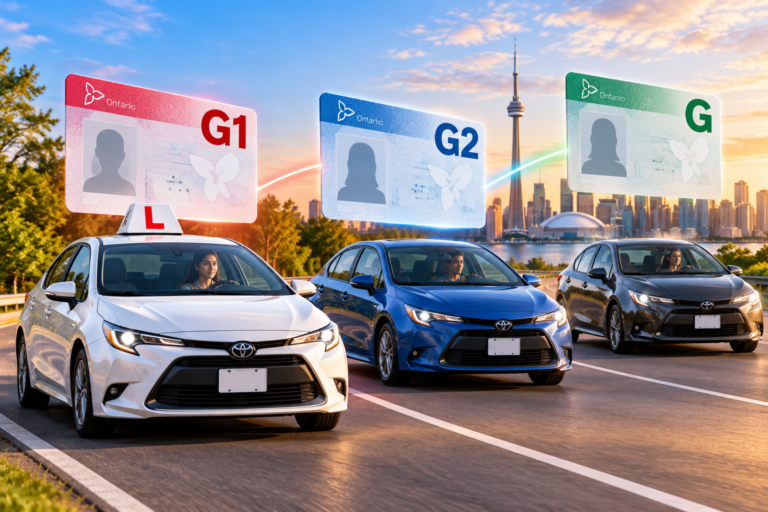
- With a G1 licence: you may not drive on 400-series highways or high-speed expressways — unless you are driving with a driver instructor certified in Ontario. With an instructor you can drive on any road.
- With a G2 licence: you may drive on all Ontario roads, including highways, on your own.
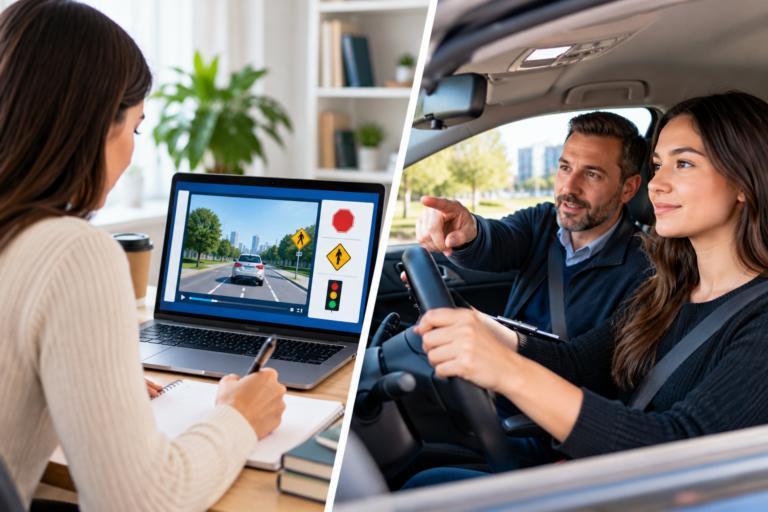
That instructor exception is the reason a lesson is the fastest way to get your first highway experience. At G1 it is the only legal way, and at G2 it is the safest way to build the experience the G test requires.
How Do You Merge Onto a Highway?
Merging onto a highway is the skill that makes new drivers most nervous, and almost all of the nerves come from doing it too slowly. Knowing how to merge properly removes most of the fear in a single lesson.
Use the whole acceleration lane
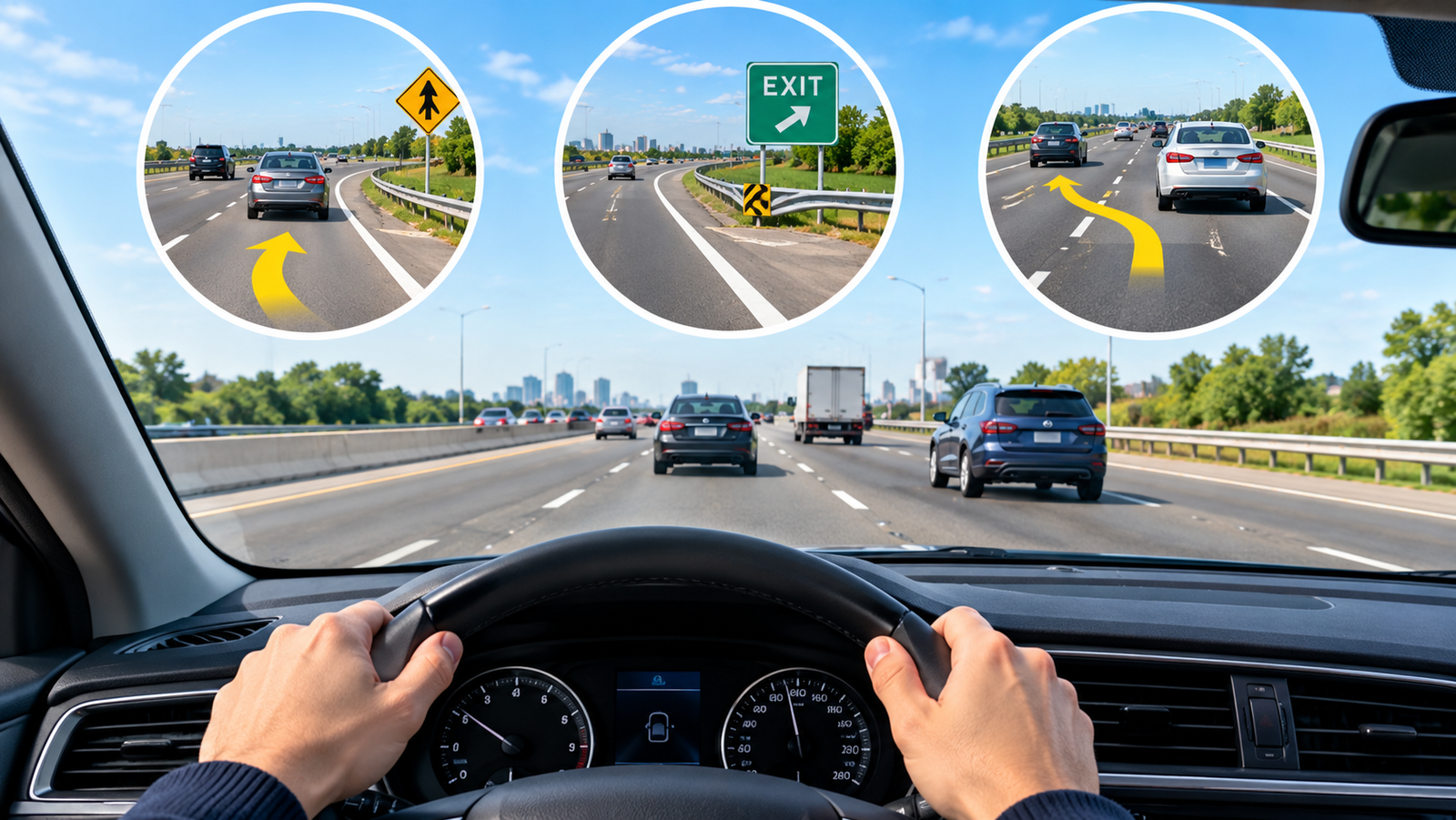
The handbook is direct about this: while you are in the acceleration lane, signal and increase your speed to merge smoothly with traffic, assessing the traffic as you go to see where you will move into the nearest freeway lane.
The acceleration lane exists so you can reach highway speed before you join. Treating it as a queue — crawling to the end of it and then trying to squeeze in — is what creates the dangerous moment.
The merge, step by step
- Signal early as you enter the acceleration lane.
- Look ahead and to your left to find the gap you are aiming for.
- Accelerate to match the speed of traffic in the right-hand lane.
- Check your blind spot over your left shoulder — mirrors alone are not enough.
- Steer gradually into the gap. Do not slow down as you move across.
- Cancel your signal and settle into a steady speed and following distance.
What if there is no gap?
Adjust your speed within the acceleration lane to line yourself up with a gap, rather than stopping. Traffic on the highway may move over for you, but never assume it will. Your job is to fit into the traffic, not to make traffic fit around you.
How Do You Drive Safely Along the Highway?
Once you are on, the handbook’s advice is about rhythm and space:
- Keep a steady speed, looking forward and anticipating what is going to happen on the road ahead.
- Keep your vision moving — scan the road ahead, to each side and behind.
- Look ahead 15 to 20 seconds, or as far ahead as you can see.
- Traffic should keep to the right, using the left lanes for passing.
- On two-lane sections you may see a passing lane sign where a climbing or passing lane opens up. DriveTest names driving in passing lanes among the skills to practise before a road test.
- Leave space around your vehicle. That lets you see clearly in every direction and gives you time and space to react.
On following distance, the two-second minimum from city driving is a floor, not a target. It applies to ideal conditions, and you need more space in bad weather, behind motorcycles or large trucks, or when carrying a heavy load. At highway speed, two seconds covers a lot more ground than it does at 50 km/h.
The “keep right except to pass” rule is the one new drivers break most often, usually by settling into the middle lane and staying there. On a road test it reads as poor lane discipline.
How Do You Change Lanes on the Highway?
The handbook gives four steps. Learn them in this order and they become automatic:
- Check your mirrors for a space in traffic where you can enter safely.
- Check your blind spot by looking over your shoulder in the direction of the lane change.
- Check again to make sure the way is clear and that no one is coming too fast.
- Steer gradually into the new lane. Do not slow down — maintain the same speed or gently increase it.
And the warning that goes with it: never make sudden lane changes by cutting in front of another vehicle.
Two details matter more at highway speed than anywhere else. First, “no one is coming too fast” is a real check — a gap that looks fine can close in a second if the car behind it is moving much quicker than you. Second, slowing down mid-change is what causes problems behind you. Hold your speed through the move.
When Can You Pass, and When Must You Not?
Before passing, signal, check your mirrors and check your blind spot. Then there are specific places where passing is not allowed:
| Situation | The rule |
| Near a pedestrian crossover | Passing within 30 metres of a pedestrian crossover is not permitted |
| Near a bridge, viaduct or tunnel | Passing left of a centreline is not permitted within 30 metres of a bridge, viaduct or tunnel |
| Approaching a hill crest | Never pass when approaching the crest of a hill where your view of oncoming traffic is obstructed |
| On a blind curve | Never pass on a curve where your view of oncoming traffic is obstructed |
Passing on the right
You may pass on the right on multi-lane or one-way roads, and when overtaking a streetcar or a left-turning vehicle. On a multi-lane highway this is normal. It is not an excuse to weave between lanes looking for gaps.
When someone wants to pass you
When faster traffic wants to pass you, move to the right and let it pass in safety. Do not speed up, and do not take it personally. Letting a faster driver past removes them from behind you, which is where they are a problem.
How Do You Exit a Highway?
Exiting catches people out in two ways, and both are easy to fix.
Do not slow down too early
Move into the deceleration lane first. The handbook says plainly: do not slow down before you are in it. Braking in a through driving lane forces everyone behind you to react. Once you are in the deceleration lane, reduce your speed gradually to the speed shown for the exit ramp.
Watch out for speed adaptation
The handbook has a name for the second problem: speed adaptation, or velocitization. After a stretch at highway speed, you may not realize how fast you are going, because you are used to the high speed of the freeway.
The fix is simple and it works: look at your speedometer on the exit ramp instead of trusting how the speed feels. Ramps often carry a posted advisory speed for a reason — the curve is tighter than it looks at 100 km/h.
Plan your exit early. Read the advance signs, get into the right-hand lane in good time, and do not make a last-second dive across lanes because you nearly missed it. If you do miss an exit, take the next one. It costs a few minutes; the alternative costs a lot more.
How Do You Share the Highway With Trucks?
Large commercial vehicles behave differently from cars, and new drivers underestimate how much.
- They have large blind spots to the sides and back. If you cannot see the driver’s mirrors, they probably cannot see you.
- Do not sit alongside a truck. Pass decisively or stay back where you are visible.
- Long commercial vehicles (LCVs) are double trailers and can be up to 40 metres long. Before passing one, allow for both the extra length and its limited speed.
- Give trucks more following distance. They are heavier and your view ahead is completely blocked behind one.
- Watch for spray and wind when passing large vehicles in rain or crosswinds.
What Are the Most Common Highway Mistakes?
- Merging below the speed of traffic. The single biggest one.
- Mirror-only lane changes. The shoulder check is not optional.
- Cruising in the middle or left lane instead of keeping right.
- Braking in a through lane before the exit.
- Following too closely at speed, where two seconds is a minimum rather than a plan.
- Drifting while checking a blind spot. Practise holding a straight line while you turn your head.
- Missing an exit and cutting across. Take the next one.
- Sitting in a truck’s blind spot without realizing it.
Is Highway Driving on Your Road Test?
Does the G2 test go on highway roads? No — highway driving is the focus of the G road test, not the G2. The G2 is a city test on regular streets. For the full picture, including the highway driving experience you must declare before your G test, read our G road test guide
If you are still working toward your G2, the G2 road test guide and our road test tips cover what that test checks.
What About Winter Highway Driving?
In Barrie and Simcoe County, highway conditions change fast, and the same stretch of Highway 400 behaves very differently in February than in July.
- Slow down below the posted limit when conditions call for it. The handbook is clear that you should always drive at a speed that lets you stop safely.
- Increase your following distance well beyond two seconds on snow or ice.
- Brake and steer gently. Sudden inputs at speed on a slippery surface are what cause skids.
- Clear your whole vehicle before you set off, including the roof, lights and all windows.
- Watch for bridges and overpasses, which freeze before the rest of the road.
Conclusion
Highway skills are hard to build alone, because the moment you most need feedback is the moment you are least able to ask for it. Go Drive Driving School offers G road test preparation with one-on-one in-car lessons on real highways, so merging, lane changes and exits feel routine long before your test date. See our programs and fees or contact us at 705-717-0406
Highway Driving FAQs
Can I drive on the highway with a G1?
Not on 400-series highways or high-speed expressways, unless you are with a driver instructor certified in Ontario.
How fast should I be going when I merge?
At the speed of the traffic you are joining. Use the acceleration lane to get there before you move across.
Which lane should I drive in?
Keep to the right, and use the left lanes for passing.
How much following distance do I need on the highway?
At least two seconds in ideal conditions, and more in bad weather, behind large vehicles or when carrying a load. Two seconds covers far more distance at highway speed than in town.
When do I slow down for my exit?
After you are in the deceleration lane, not before. Then reduce speed gradually to the posted ramp speed.
Why does the ramp feel so slow after the highway?
That is speed adaptation, also called velocitization. Check your speedometer rather than trusting the feeling.
Can I pass on the right?
Yes, on multi-lane or one-way roads, and when overtaking a streetcar or a left-turning vehicle.
Is highway driving on the G2 test?
No. Highway driving is the focus of the G road test.