Winter Driving Tips for Barrie and Simcoe County
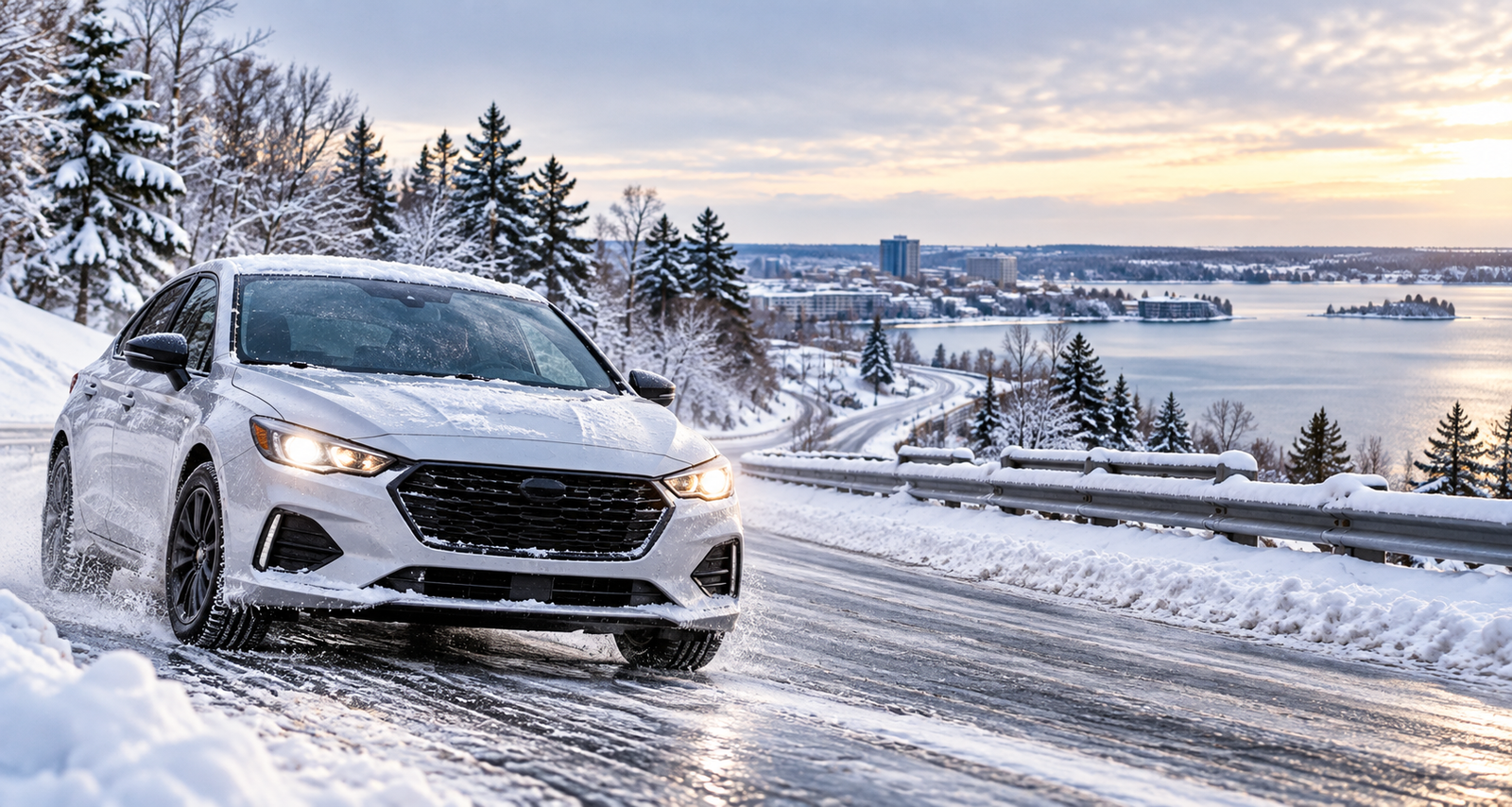
Winter driving here is not quite the same as winter driving in southern Ontario, and anyone who has driven north on a clear afternoon and hit a wall of snow twenty minutes later already knows why.
Sitting between Lake Simcoe and Georgian Bay puts Barrie and Simcoe County in lake-effect snow country. Environment Canada issues snow squall warnings for this area regularly Barrie, Orillia, Collingwood, Midland and the surrounding townships and those squalls can turn good visibility into almost none within a couple of kilometres.
So the usual winter advice applies here, and then there is a bit more.
Why Winter Driving Is Different in This Region
Most winter driving guidance assumes conditions change gradually. In squall country they often do not.
- Conditions can change within a few kilometres. A clear road and a whiteout can exist on the same stretch of highway at the same time.
- Squall bands sit still, or move. You can drive out of one in minutes, or sit in it for an hour.
- Snowfall totals are local. One town gets a few centimetres; another gets 30.
- The forecast you checked this morning may not describe this afternoon.
The practical takeaway: in this region, the question is never only “is it snowing where I am?” It is “what is it doing where I am going?” Check conditions along the whole route before you leave, not just out the window.
Getting Your Vehicle Ready
Winter tires
Winter tires are not legally required in Ontario, unlike Quebec. But the province is clear about what they do.
| What Ontario says | Detail |
| Install four | “Be sure to install four winter tires — never mix different types of tires on one vehicle.” |
| Braking | Winter tires can shorten braking distances by as much as 25% |
| Temperature | All-season tires “can start to lose grip at 7°C“ |
| How to identify one | Look for the three-peak mountain snowflake symbol on the tire |
| Insurance | Winter tires can earn an auto insurance discount — ask your insurer |
That 7°C figure is the one most people have not heard. All-seasons begin losing grip well before the first snow falls — which in this area means the tires are already past their best during October mornings.
Ontario says winter tires can earn an insurance discount. Whether you get one, and how much, is up to your insurer. Ask before you assume.
The rest of the vehicle
- Get a maintenance checkup so the vehicle is winter-ready.
- Keep the fuel tank at least half full — it reduces moisture in the fuel system and adds weight.
- Carry an ice scraper, and use washer fluid rated to –40°C.
What to Keep in the Car
Ontario’s recommended winter emergency kit:
- Charged phone
- Water and non-perishable food
- Flashlight
- Blanket and warm clothes
- Jumper cables
- Shovel
- Traction mats or sand
- Candles and a lighter or matches
In squall country this is not over-preparation. Being stopped on a highway for an hour while a band passes through is an ordinary winter event here, not a disaster scenario.
Driving in a Snow Squall or Whiteout
This is the section that matters most locally.
- Use your full lighting system in poor visibility and whiteout conditions — not just daytime running lights, which leave your tail lights off.
- Slow down before you need to. Reducing speed inside a whiteout is harder and more dangerous than reducing it beforehand.
- Increase your following distance well beyond the usual two seconds. The handbook is explicit that the two-second rule is a minimum for ideal conditions.
- If conditions become dangerous, pull over safely and wait for the weather to improve.
Pulling over means getting properly off the road — not stopping in a live lane with hazards on. A stopped car in a whiteout is very hard to see, and other drivers will not have the visibility to avoid it.
The lane discipline and visibility habits that matter here are the same ones we cover in highway driving tips for new drivers they just matter more.
Black Ice: Where It Forms
Ontario gives a simple visual test. In winter, asphalt should look grey-white. If the road “looks black and shiny it could be covered in ice.”
And it does not form evenly. These spots freeze earlier than the rest of the road:
- Shaded areas — under trees, beside buildings, in cuttings
- Bridges
- Overpasses
Bridges and overpasses lose heat from above and below, so they ice up while the approach road is still wet. This is worth knowing on any route with overpasses — and the 400-series corridor through this region has plenty.
If You Start to Skid
Ontario’s instruction is short and worth memorising, because there is no time to think about it in the moment:
Release your brakes and steer in the direction you want to go. Do not steer too far, or the car could spin.
The instinct is to brake harder and turn sharply. Both make it worse. Easing off and steering smoothly is what brings the car back.
This is exactly the kind of response worth practising with an instructor before you need it, rather than discovering on a January morning.
Sharing the Road With Snowplows
Plows are a constant presence here through the winter. Ontario is direct about them:
- Never pass a working snowplow. It is “very dangerous for you and the plow driver.”
- Stay back from plows and winter maintenance vehicles with flashing blue lights.
- Blowing snow and the snow ridge a plow creates can greatly reduce visibility.
Roads are plowed in sections, so you usually will not be behind a plow for more than 20 to 30 minutes. The road behind a plow is the best-cleared surface available — staying there is the safer and often faster choice.
Watch for Large Trucks
The 400 corridor carries heavy truck traffic year-round. One number is worth carrying in your head:
A tractor-trailer’s braking distance is 4 to 10 times longer on ice than on dry road.
Cutting in front of a truck is a poor idea in July. In February it removes the only stopping distance the driver has.
Your First Winter as a New Driver
If you got your G1 or G2 this year, this is the season that teaches you the most — and it is the one where the habits built in good weather get tested.
- Practise in a safe open space first if you can, with a licensed driver beside you, so the first time the car moves under you is not in traffic.
- Give yourself more time. Most winter mistakes are made by people who are late.
- Clear the whole car, not a porthole in the windscreen — including the roof, lights and plates.
- Do not rely on cruise control. Ontario advises against it on wet, icy or slippery roads.
The underlying skill is anticipation, which we cover in what defensive driving actually means. Winter does not require different techniques so much as earlier ones.
Road Tests in Winter
Road tests do run through the winter, and DriveTest can cancel appointments when conditions are unsafe. A few practical points:
- Your vehicle still has to meet the test requirements including working wipers with washer fluid, a working defroster, and a windscreen clear enough to see through.
- Snow and ice on the car can be a reason a test does not go ahead, so clear it properly before you arrive.
- If the weather is bad, check your appointment status before travelling to the centre.
For everything the examiner checks before a test begins, see our G2 road test guide
Conclusion
Winter is the season new drivers worry about most, and the one where an instructor beside you is worth the most. Go Drive Driving School is MTO approved and teaches new drivers across Barrie, Innisfil, Bradford, Midhurst, Springwater, Orillia, Alliston, Cookstown and Angus. See our programs and fees or contact us at 705-717-0406. New to the licensing process? Start with how Ontario’s graduated licensing system works
FAQs
Are winter tires required in Ontario?
No. They are required in Quebec but not in Ontario. Ontario recommends installing four of them and notes they can shorten braking distances by as much as 25%.
When should I put winter tires on?
Ontario notes that all-season tires can start to lose grip at 7°C, which in this region generally means well before the first snowfall.
How do I know if a tire is a true winter tire?
Look for the three-peak mountain snowflake symbol on the tire itself.
What should I do in a snow squall?
Use your full lighting system, slow down, increase your following distance, and if conditions become dangerous pull over safely off the road and wait.
Where is black ice most likely?
Shaded areas, bridges and overpasses freeze earlier than other sections of road. If the asphalt looks black and shiny rather than grey-white, treat it as ice.
What do I do if my car skids?
Release the brakes and steer in the direction you want to go, without steering too far.
Can I take my road test in winter?
Yes, road tests run year-round, though appointments can be cancelled in unsafe conditions. Your vehicle still has to meet all the usual requirements.
Should I pass a snowplow?
No. Ontario says never pass a working snowplow. Stay back, and remember roads are plowed in sections so the wait is usually 20 to 30 minutes at most.