Ontario Road Signs Test: Every Sign Category Explained
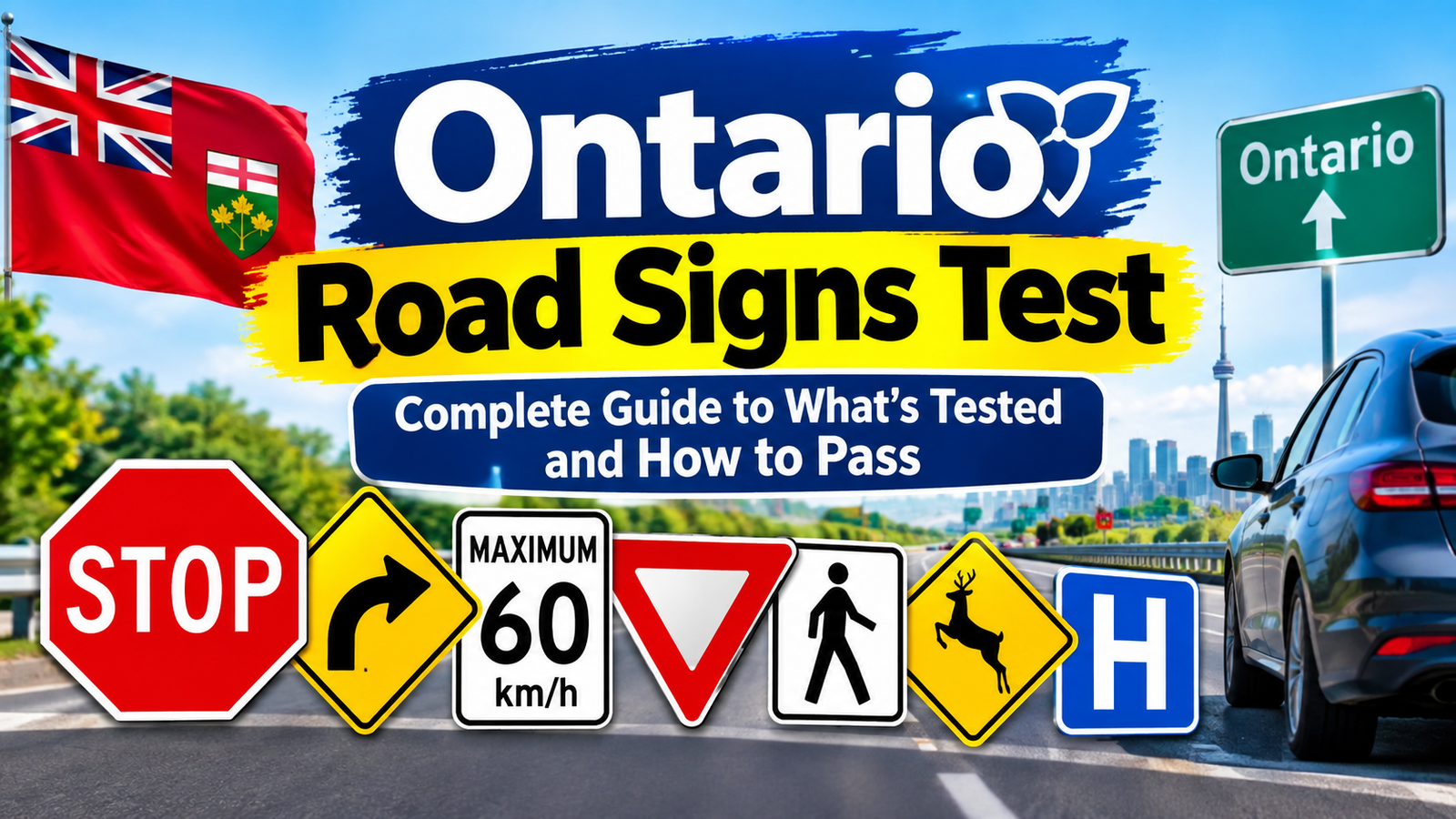
Road signs are a big part of the G1 knowledge test, and they are one of the easiest places to lose marks if you only skim the handbook. The good news is that Ontario signs follow a clear system. Once you learn how shapes and colours work, most signs start to make sense even before you read them.
This guide walks you through every sign category in the Official MTO Driver’s Handbook, plus traffic lights and pavement markings, so you can walk into DriveTest feeling ready.
Ontario Road Signs by Shape & Colour
Learn these patterns and most signs make sense at a glance.
Stop sign
Eight-sided, red. Come to a complete stop.
Yield sign
White triangle, red border. Let other traffic go first.
School zone
Five-sided, fluorescent yellow-green. Slow down, watch for children.
Railway crossing
White X, red outline. Look both ways, be ready to stop.
Regulatory
Rectangle or square, white or black. A rule you must obey.
Warning
Yellow diamond. Dangerous or unusual conditions ahead.
Temporary conditions
Orange diamond. Road work, detours, lane closures.
Information & direction
Green rectangle. Distances and destinations.
Not allowed
Red circle with a line: the activity shown is prohibited.
Allowed / required
Green circle: you may or must do the activity shown.
Slow-moving vehicle
Orange triangle, red border. 40 km/h or less.
Sharp turn
Checkerboard border: sharp bend in the arrow’s direction.
Simplified illustrations for study. See the Official MTO Driver’s Handbook for every sign.
What Is the Road Signs Part of the G1 Test?
The G1 knowledge test checks what you know about the rules of the road and traffic signs. Most G1 study guides describe it as 40 multiple-choice questions, with 20 questions on road signs. They also explain that you need at least 16 correct in each section, so a great rules score cannot make up for a weak signs score. Check DriveTest for the current format before test day.
Want to see where you stand right now? Try our free G1 practice test after reading this guide.
How Can You Tell What a Sign Means From Its Shape and Colour?
Ontario signs use shapes, colours and symbols so drivers can identify them quickly. Learn this table first. It will help you answer many questions even when you do not recognize the exact sign.
| Shape and colour | Sign type | What it tells you |
| Eight-sided, red with white letters | Stop sign | Come to a complete stop |
| Triangle, white with red border | Yield sign | Let traffic in or near the intersection go first |
| Five-sided, fluorescent yellow-green | School zone sign | Slow down and watch for children |
| X-shaped, white with red outline | Railway crossing sign | Tracks cross the road; be ready to stop |
| Rectangle or square, white or black background | Regulatory sign | A rule you must obey |
| Diamond, yellow with black symbols | Warning sign | Dangerous or unusual conditions ahead |
| Diamond, orange with black symbols | Temporary condition sign | Road work, detours, lane closures |
| Rectangle, green with white letters | Information and direction sign | Distances and destinations |
| Triangle, orange with red border | Slow-moving vehicle sign | Vehicle travels at 40 km/h or less |
What Do the Four Special Signs Mean?
The handbook lists four signs on their own because each has a unique shape you should never mix up.
Stop sign
Eight-sided with a red background and white letters. You must come to a complete stop. Stop at the stop line if there is one. If not, stop at the crosswalk. If there is no crosswalk, stop at the edge of the sidewalk, and if there is no sidewalk, stop at the edge of the intersection. Go only when the way is clear.
School zone sign
Five-sided with a fluorescent yellow-green background and black symbols. It warns that you are coming to a school zone. Slow down, drive with extra care and watch for children.
Yield sign
A triangle with a white background and red border. Let traffic in the intersection, or close to it, go first. Stop if you need to, and go only when it is clear.
Railway crossing sign
X-shaped with a white background and red outline. Railway tracks cross the road ahead. Slow down, look both ways and be prepared to stop.
What Are Regulatory Signs?
Regulatory signs give directions you must obey. They are usually rectangular or square, with a white or black background and black, white or coloured letters.
Two symbols appear on many of them:
- Green circle: you may, or must, do the activity shown inside the ring.
- Red circle with a line through it: the activity shown is not allowed.
Common regulatory signs include do not enter, no left turn, no U-turn, no right turn on red, do not pass, one-way traffic, keep right of the traffic island, and slow traffic keep right. You will also see signs for bicycle routes, reserved lanes (such as buses, taxis, carpools or bicycles), two-way left-turn lanes and pedestrian crossovers.
No stopping, no standing and no parking: what is the difference?
These three signs are used in pairs or groups and are easy to confuse on the test:
| Sign | What you may do between the signs |
| No stopping | Nothing. You may not stop, even for a moment. |
| No standing | Stop only while loading or unloading passengers. |
| No parking | Stop only to load or unload passengers or merchandise. |
Special zones and school bus signs
- Community safety zone: the community has identified a special risk to pedestrians. Traffic offences here carry increased fines.
- School zone speed limit sign: the speed limit is lower during school hours. Obey the limit shown when the yellow lights are flashing.
- Stop for school bus when signals flashing: a reminder of the school bus law. On multi-lane roads with no centre median, a sign tells drivers from both directions that they must stop.
- School bus loading zone: marks an area where school buses load and unload without using their red lights and stop arm.
- Yield to bus sign: found on the back of transit buses. Drivers approaching a bus stopped at a bus stop must yield once the bus signals that it is pulling back into the lane.
What Are Warning Signs?
Warning signs tell you about dangerous or unusual conditions ahead, such as a curve, turn, dip or side road. They are usually diamond-shaped with a yellow background and black letters or symbols.
Examples you should know include:
- Curves and turns: slight bend, sharp bend, winding road, and chevron signs that guide you around sharp curves.
- Checkerboard border with an arrow: a sharp turn or bend in the direction of the arrow. Slow down.
- Speed tab under a curve sign: the maximum safe speed for that curve. A similar sign shows the maximum safe speed on a ramp.
- Stop sign ahead and traffic lights ahead: slow down and be ready to stop.
- Right lane ends: merge safely into the lane on your left.
- Two roads merging: drivers on both roads are equally responsible for merging smoothly.
- Divided highway begins / ends: keep to the right-hand road.
- Roundabout ahead: reduce speed; arrows show counter-clockwise traffic flow.
- Hidden school bus stop ahead: slow down and watch for children and a school bus with flashing red lights.
- Hazard marker: an object close to the road edge. The downward lines show the side where you can pass safely.
- Other hazards: slippery when wet, narrow bridge, pavement narrows, bump, steep hill, deer crossing, fallen rock, water over the road, and railway crossing ahead.
What Are Temporary Condition Signs?
These signs warn about short-term conditions like road work, detours, lane closures or traffic control people. They are usually diamond-shaped with an orange background and black letters or symbols. Tip: yellow means a permanent warning; orange means something temporary.
- Construction zone: drive with extra caution and expect a lower speed limit.
- Traffic control person ahead: drive slowly and watch for instructions.
- Lane closed ahead: obey the speed limit and merge into the open lane.
- Doubled fines sign: speeding fines are doubled in a designated construction zone when workers are present.
- Grooved or milled pavement: your stopping ability may be affected.
- Pilot vehicle sign: do not pass the pilot or pace vehicle.
- Detour markers: follow them until you return to your regular route.
What Are Information and Direction Signs?
These signs help you find your way. They are usually rectangular with a green background and white letters. Signs in other colours guide you to facilities, services and attractions.
- Directions and distances (in kilometres) to towns and cities
- Freeway exit signs, including overhead signs that show which lanes lead off the freeway
- Interchange numbers: these match the distance from the start of the freeway. For example, interchange 204 on Highway 401 is 204 km from Windsor, where the freeway begins.
- “VIA” signs that show which roads to follow to reach a destination
- Roundabout exit signs, changeable message signs, and signs for hospitals, airports, train stations and carpool lots
What Other Signs Should You Know?
- Slow-moving vehicle sign: an orange triangle with a red border on vehicles that travel at 40 km/h or less, such as farm tractors. Reduce your speed as needed.
- Emergency Detour Route (EDR) signs: guide drivers around an unscheduled highway closure and back onto the highway.
- Long commercial vehicle (LCV) placard: marks a double-trailer vehicle that can be up to 40 metres long. Plan for its length and limited speed before passing.
- Emergency response numbers: some information signs have numbers along the bottom to help emergency vehicles choose a route.
- Bilingual signs: in designated areas, read the message in the language you understand best.
What Do Traffic Lights and Beacons Mean?
Traffic lights are covered in the same handbook chapter as signs, so study them together.
| Light | What to do |
| Green | Go straight or turn after yielding to vehicles and pedestrians already in the intersection |
| Yellow (amber) | Red is coming. Stop if you can do so safely; otherwise go with caution |
| Red | Come to a complete stop and wait for green |
| Flashing green, or left green arrow with green light | Advance green: you may turn left, go straight or turn right from the proper lane |
| Left green arrow with red light | You may turn left from the left-turn lane; oncoming drivers may also be turning left |
| Yellow arrow after a green arrow | Do not start your left turn; stop if you safely can |
| Flashing red light or beacon | Come to a complete stop; go only when safe |
| Flashing yellow light or beacon | Drive with caution |
| Blank lights (power failure) | Treat the intersection like an all-way stop |
| Transit priority signal (white vertical bar) | Yield to public transit vehicles |
Turning on red: unless a sign says otherwise, you may turn right on a red light after a complete stop, once the way is clear. You may also turn left on red from a one-way road onto a one-way road, again only after a complete stop.
What Do Pavement Markings Mean?
- Yellow lines separate traffic going in opposite directions. White lines separate traffic going the same way.
- Solid line on your left: it is unsafe to pass. Broken line on your left: you may pass if the way is clear.
- Continuity lines (wider, closer broken lines): on your left, your lane is usually ending or exiting; on your right, your lane continues.
- Stop line: a single white line across the road showing where to stop.
- Crosswalk: two parallel white lines across the road (though not all crosswalks are marked).
- White arrows: you may move only in the direction of the arrow.
- Pedestrian crossover: two white double parallel lines across the road with an X in each approaching lane. Stop before the line and wait until pedestrians have completely crossed.
- Solid lines around objects: guide traffic away from bridge piers or concrete islands.
How Should You Study for the Road Signs Test?
- Learn shapes and colours first. Use the table above as your base.
- Read every sign in the handbook. The Signs section has many signs that are easy to skip.
- Make flashcards with the picture on one side and the meaning on the other.
- Focus on look-alikes: no stopping vs. no standing vs. no parking, yellow vs. orange diamonds, and stop sign vs. stop sign ahead.
- Test yourself often. Use our G1 practice test and choose “Road signs only”.
- Spot signs as a passenger. Say what each sign means out loud during everyday drives.
What Are the Most Common Road Sign Mistakes?
- Mixing up no stopping, no standing and no parking. Remember: stopping is strictest, parking is least strict.
- Confusing the school zone sign with a warning sign. The school zone sign is five-sided, not a diamond.
- Treating orange signs like yellow ones. Orange means temporary conditions such as road work.
- Thinking a flashing red light means “slow down”. It means a full stop, just like a stop sign.
- Forgetting that yield can mean stop. You must stop if traffic requires it.
Ready for the Next Step?
Once you pass your G1, the real learning starts on the road. Go Drive Driving School offers an Online Beginner Driver Education (BDE) course and one-on-one in-car lessons for new drivers in Barrie and nearby areas. Completing a government-approved driver education course lets you take your first road test after 8 months instead of 12. See our programs and fees or contact us at 705-717-0406.
Keep learning: G1 Test Rules Every New Driver Should Know
FAQs
How many road sign questions are on the G1 test?
Most study guides describe 20 road sign questions out of 40 total, with at least 16 correct needed in that section.
What shape is a warning sign in Ontario?
Warning signs are usually diamond-shaped with a yellow background and black letters or symbols.
What colour are construction signs?
Temporary condition signs, including construction signs, are usually diamond-shaped with an orange background.
What does a five-sided sign mean?
A five-sided fluorescent yellow-green sign warns that you are coming to a school zone.
Can you turn right on a red light in Ontario?
Yes, after a complete stop and when the way is clear, unless a sign says you cannot.
What is a community safety zone?
An area where the community has identified a special risk to pedestrians. Traffic offences there carry increased fines.
Do I need to know pavement markings for the G1?
Pavement markings are in the same handbook chapter as signs and traffic lights, so study them as part of your sign preparation.