Online vs In-Car Driver Training: What Each Covers
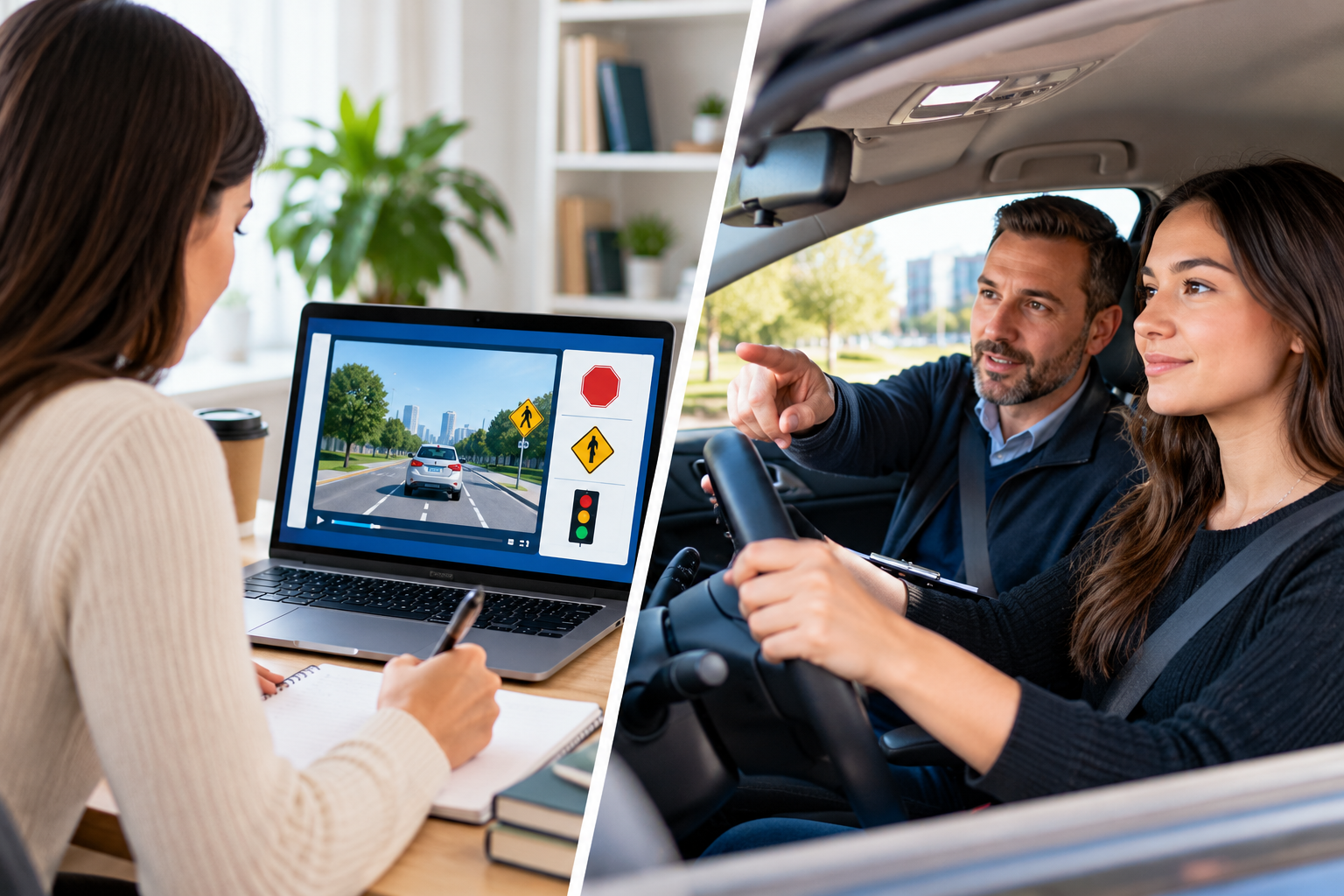
Search for an “online driving school” in Ontario and you will find plenty of them. What is less obvious is what “online” actually covers and what it cannot.
The short version: online driver training is the classroom half of a Beginner Driver Education (BDE) course. In-car training is the driving half. They are not alternatives to each other. A government-approved course includes both.
Here is exactly what each part covers, and how to choose between the formats that genuinely are a choice.
Online vs In-Car Training at a Glance
| Online (classroom) training | In-car training | |
| Minimum hours | 20 hours | 10 hours |
| Where | Your own device, or a classroom | In a car, on real roads |
| Who delivers it | An approved driving school | A licensed instructor |
| Can it be done online? | Yes — digitally or in person | No |
| What it covers | Rules, signs, theory, safe driving practices | Actual vehicle control and road skills |
| Is it optional? | No — both are required in a BDE course | No |
That last row is the one people miss. Online and in-car are not two products to pick between. They are two required components of the same 40-hour course.
What Does Online Driver Training Cover?
Ontario allows the 20 hours of classroom instruction to be delivered digitally or in person. That is what an “online driving school” in Ontario is actually offering: the classroom portion, delivered through a screen instead of a room.
You will see it labelled all sorts of ways — online driver training, online drivers education, drivers education online classes, or simply an online driving course. They all refer to the same thing: the classroom hours, delivered through a screen.
The subject matter is the theory a new driver needs:
- Rules of the road and the Highway Traffic Act basics
- Traffic signs, signals and pavement markings
- Right-of-way and intersection rules
- Safe driving practices, following distance and hazard awareness
- Driving in poor weather and at night
- Impaired and distracted driving, and the penalties for new drivers
This is the same ground the G1 knowledge test covers, which is why a lot of students find the classroom hours reinforce what they already studied. Our G1 test study guide covers that side in detail.
What Does In-Car Training Cover?
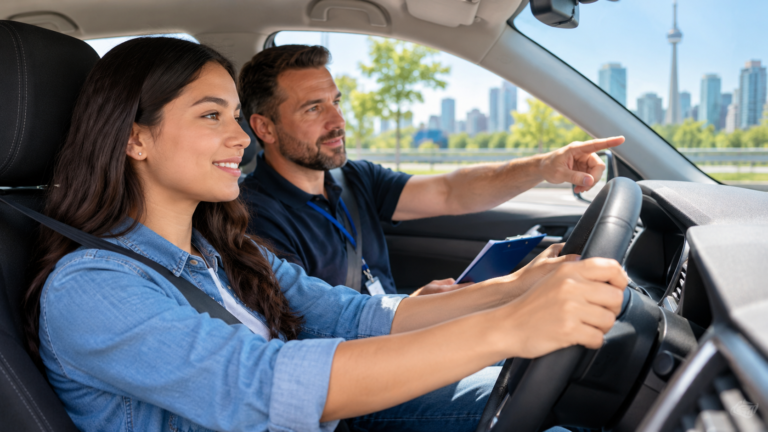
The 10 hours of in-vehicle training must be delivered by a licensed instructor in a car, on real roads. No simulator, app or video replaces it.
This is where you actually learn to drive:
- Vehicle control — steering, braking, accelerating smoothly
- Observation habits — mirrors, blind spots and shoulder checks
- Turns, lane changes and intersection judgment in live traffic
- Parallel parking, three-point turns and roadside stops
- Reading and responding to other road users
- Building the habits a road test examiner is looking for
If you want to see how those skills map onto the test itself, our G2 road test guide lists what gets assessed.
Can You Learn to Drive Entirely Online?
No — and this is the single most important thing to understand before you pay for anything.
An approved Ontario BDE course always includes 10 hours of in-vehicle training with a licensed instructor. Any course advertising that you can complete driver training, get certified, or get licensed without ever getting in a car with an instructor is not a government-approved BDE course.
“Online driving school” is a slightly misleading phrase for that reason. What is online is the theory. The practical training is always in person, and it always has been.
It is worth remembering what the Ontario government itself lists as warning signs of a bad driving school: offers of a “guaranteed licence” or to “pass without a road test”, training vehicles not properly equipped with a dual brake, and insistence on cash-only payments without providing a receipt. An “all-online” claim belongs in the same category.
What About the Flex Hours?
A BDE course has a third component that confuses people: 10 hours of flexible instruction time, on top of the 20 classroom and 10 in-vehicle hours.
According to the Ontario government, flex time can be delivered as:
- Classroom instruction
- Digital instruction
- In-vehicle instruction
- Driving simulator instruction
- Homelinks — structured take-home work
So the flex hours can be online, in a car, or something in between. This is where schools differ most, and it is worth asking about.
Good question to ask before you enrol: “How do you deliver your 10 flex hours?” A school that puts some of them into extra in-vehicle time or simulator work is offering something materially different from one that uses all ten for take-home exercises.
How Do the Three Parts Add Up?
| Component | Minimum hours | Online possible? |
| Classroom instruction | 20 hours | Yes — digital or in person |
| In-vehicle training | 10 hours | No — licensed instructor, in a car |
| Flexible instruction time | 10 hours | Partly — depends on the school |
| Total | 40 hours |
Should You Choose Online or In-Person Classroom?
This is the part that genuinely is a choice, because the government treats both the same way.
Online classroom suits you if:
- You are balancing school, work or sport and need to fit the hours around a timetable
- You live outside the town where the school runs its classroom sessions
- You prefer working through material at your own pace, and re-reading the parts that did not land
- You want to start immediately rather than wait for the next scheduled class
In-person classroom suits you if:
- You concentrate better in a structured room with a set schedule
- You want to ask questions as they come up and hear other students’ questions
- You know you will procrastinate on self-paced material
- You find screen-based learning tiring
Neither is better. Both lead to the same certificate, because the province’s requirement is identical either way.
Does the Format Change Anything Else?
No — and this is reassuring if you are worried that an online course somehow counts for less.
| Does online classroom change… | Answer |
| The certificate you receive | No — same certification process either way |
| How you are certified | No — the school certifies you online and your driver record is updated through MTO |
| The 8-months-instead-of-12 benefit | No — the benefit comes from completing an approved course, not from its format |
| Your insurance position | No — though note the province says completing a course does not guarantee a discount |
| The total hours required | No — still 40 hours |
On the insurance point specifically, we go into what the government actually says in does a driving course lower car insurance in Ontario?
What Deadline Applies?
One rule catches out online students in particular: your in-vehicle training must be completed within 1 year from the start of your classroom instruction.
It is easy to blast through 20 hours of online theory over a school break, then leave the driving for later. Book your in-car sessions early rather than letting the clock run down.
Questions to Ask Before You Enrol
- “Is this the government-approved BDE course, or just a package of lessons?” They are different products.
- “Is the classroom portion online, in person, or either?”
- “How do you deliver the 10 flex hours?”
- “When can I start my in-car lessons, and how far apart are they?”
- “Are your instructors licensed, and do your cars have dual brakes?”
- “Are you on the [government-approved list](https://www.ontario.ca/page/government-approved-driving-schools), and not on the revoked schools list?”
Common Myths About Online Driver Training
- “Online courses are not really approved.” Not true. The province allows classroom instruction digitally or in person, and approved schools can deliver it either way.
- “You can skip the in-car hours if you do a good online course.” False. The 10 in-vehicle hours are required, with a licensed instructor.
- “Online means you learn alone.” Not necessarily — delivery varies by school. Ask how yours is structured.
- “Online is the cheap option.” Price depends on the school, not the format. Compare what is actually included.
- “An online course is faster.” You may finish the theory sooner, but the in-car hours and the licensing timelines are unchanged.
Conclusion
Go Drive Driving School is MTO approved and offers an MTO-approved BDE course covering the full 40 hours the province requires the classroom instruction, the 10 hours of in-vehicle training with licensed instructors, and the flex time for new drivers in Barrie, Innisfil, Bradford, Midhurst, Springwater, Orillia, Alliston, Cookstown and Angus. See our programs and fees or contact us at 705-717-0406.
Want the full picture first? Read what a BDE course in Ontario involves
FAQs
Can you do driving school online in Ontario?
You can do the classroom portion online — 20 hours, digitally or in person. The 10 hours of in-vehicle training must be done with a licensed instructor in a car.
Can you learn to drive online?
No. You can learn the theory online, but the driving itself is taught in a car with an instructor.
Is online driving school legitimate in Ontario?
Yes, as long as the school is government approved. Check the ministry’s list of approved driving schools before you pay.
Is online driver training as good as in-person classroom?
Both meet the same provincial requirement and lead to the same certificate. Which suits you depends on how you learn and how your schedule works.
How many hours of in-car training do I need?
A minimum of 10 hours, delivered by a licensed instructor. Some of the 10 flex hours may also be used for in-vehicle time, depending on the school.
Does an online course still get me my G2 test sooner?
Yes. Completing a government-approved driver education course lets you take your first road test after 8 months instead of 12, regardless of whether the classroom part was online.
Can I do the flex hours online?
Partly. Flex time can cover classroom, digital, in-vehicle or simulator instruction and homelinks, so it depends how your school structures it.
What happens if I do not finish the in-car hours in time?
Your in-vehicle training must be completed within one year of starting your classroom instruction, so book the driving sessions early.