What Is the G1 Exit Test?

If you’ve searched “G2 test” or “G1 exit test” and weren’t sure whether they’re the same thing, you’re not alone. Many new drivers in Ontario don’t realize that the road test which moves you from a G1 licence to a G2 licence has an official name the G1 Exit Test. It shows up under this name on booking pages and official documents, which is often where the confusion starts.
This guide explains exactly what the G1 Exit Test is, who needs it, how long you’ll wait, what happens on test day, and how to prepare, in plain, easy-to-understand language for Ontario drivers.
What Is the G1 Exit Test?
The G1 Exit Test is the official term the Ministry of Transportation (MTO) and DriveTest use for the road test that lets you move from a G1 licence to a G2 licence. Most people simply call it the “G2 test” or “G2 road test,” but on your booking confirmation and at the DriveTest centre, you’ll usually see it listed as the G1 Exit Test.
It’s the first of two road tests in Ontario’s graduated licensing system. Passing it means you can drive on your own, without a fully licensed driver sitting beside you, although a few conditions stay in place until you earn your full G licence.
Why Does Ontario Use a Two-Stage Licensing System?
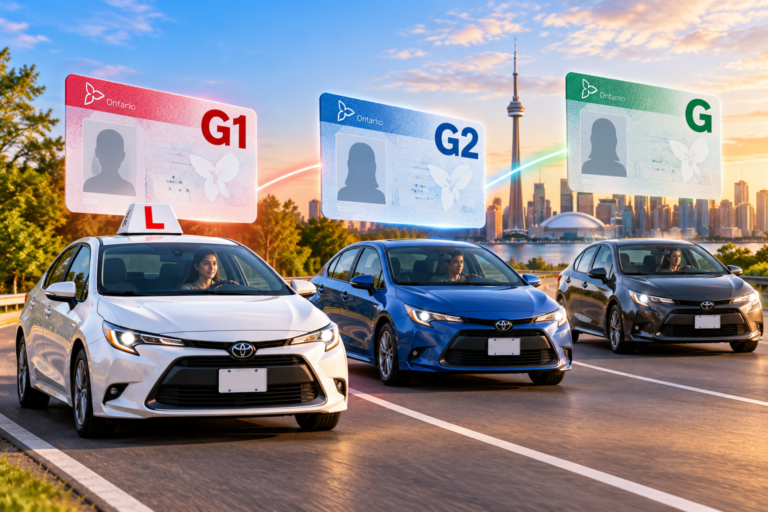
Ontario uses a graduated licensing system so new drivers build experience gradually before getting full driving privileges. There are three stages:
- G1 — a learner’s licence you get after passing a written knowledge test
- G2 — earned after passing the G1 Exit Test
- G (Full Licence) — earned after passing the second road test
Each stage removes certain restrictions as you gain experience. As a G1 driver, you can only drive with a fully licensed supervisor beside you, and there are limits on when and where you can drive. Passing the G1 Exit Test removes the supervision requirement, which is why it’s such a meaningful milestone it’s the first big step toward driving independently.
Who Needs to Take the G1 Exit Test?
Anyone who currently holds a valid G1 licence and wants to move up to a G2 licence needs to take the G1 Exit Test. This applies whether you’re a brand-new driver or someone returning to driving after time away.
You can’t skip this step. Even experienced drivers moving to Ontario from another province or country may still need to go through the graduated licensing stages, depending on their driving history and previous licence type.
How Long Do You Have to Wait Before Taking the G1 Exit Test?
In most cases, you must hold your G1 licence for at least 12 months before you’re eligible to book the G1 Exit Test.
If you complete a Ministry-approved Beginner Driver Education (BDE) course, that waiting period can be reduced to 8 months. Not every driving school offers an approved BDE course, so it’s worth confirming directly with your school or checking the Ministry of Transportation’s website.
Why Might You Still Face a Wait Even After You’re Eligible?
Being eligible to book and actually getting a test date are two different things. Ontario’s DriveTest centres have seen high demand against limited appointment slots in recent years, which means popular centres can be booked out for weeks or months, especially in spring and summer.
If your goal is to test as soon as possible, it helps to book the moment you’re eligible rather than waiting until you “feel ready,” and to stay flexible on date, time, and even nearby DriveTest locations.
What Happens During the G1 Exit Test?
The G1 Exit Test is a supervised, in-car driving test. A DriveTest examiner sits with you and evaluates your driving over a route that typically covers city and residential roads. The test usually takes around 20 minutes, though this can vary slightly by location.
Unlike the second road test, the G1 Exit Test does not include highway driving. It focuses on the everyday situations new drivers face most: intersections, turns, and parking.
What’s the Difference Between the G1 Exit Test and the Full G Test?
It’s easy to mix these up, so here’s the simple version:
- The G1 Exit Test (what most people call the “G2 test”) moves you from G1 to G2. It’s shorter, focuses on city and residential driving, and does not include highway driving.
- The G Test (sometimes called the exit test or the second road test) moves you from G2 to your full G licence. It’s longer, generally covers more advanced situations, and requires you to declare recent highway driving experience.
In other words, the G1 Exit Test is the beginning of the road test process, not the final one. Passing it is a major step, but it isn’t the last test you’ll take before earning full driving privileges.
What Skills Does the Examiner Look For?
Examiners aren’t looking for a perfect drive — they’re looking for a safe, aware, and predictable one. Rolling through a stop sign, forgetting a shoulder check, or hesitating too long at an intersection tends to matter more than one imperfect maneuver. Skills commonly evaluated during the G1 Exit Test include:
- Parallel parking
- Reverse parking
- Three-point turns
- Lane changes
- Left and right turns
- Mirror and blind-spot checks
- Speed control
- Traffic signal compliance
- Stop sign procedures
- Residential and city driving
- Busy intersection navigation
- Defensive driving habits
These are the same core skills covered in G1 test rules every new driver should know, which is a good next read if you’re still early in your G1 stage.
What Do You Need to Bring on Test Day?
Before your G1 Exit Test, make sure you have:
- Your valid G1 licence
- A roadworthy vehicle that meets DriveTest’s mechanical requirements
- Proof of insurance for the vehicle
- A fully licensed instructor or G-licensed driver accompanying you, depending on the vehicle used
Check your vehicle the day before, not the morning of. A mechanical issue or missing document is one of the most avoidable reasons for a rescheduled test.
How Much Does the G1 Exit Test Cost?
There is a fee to book and take your G1 Exit Test, set by the Ministry of Transportation. Because fees are updated from time to time, it’s best to check the official DriveTest booking page directly for the current amount rather than relying on numbers you might see on other websites.
What Happens After You Pass the G1 Exit Test?
Once you pass, you’re issued a G2 licence. This lets you drive independently, but a few restrictions stay in place until you pass your final road test. For the full breakdown of what changes and what doesn’t, see our guide on G2 licence restrictions in Ontario.
From there, you’ll need to hold your G2 licence for a minimum period before you’re eligible for the second road test, which leads to your full G licence. You can read more about that stage in our guide to the G licence road test.
What Happens If You Don’t Pass the G1 Exit Test?
It happens more often than people think, and it isn’t the end of the road. If you don’t pass, the examiner will explain the reasons, and you can book another attempt once any required waiting period has passed and the retest fee is paid.
Most students who don’t pass on their first try share similar gaps: nervousness, unfamiliarity with the test route, or a specific skill that needed more practice. None of these mean you’re not ready to drive they usually just mean a bit more targeted practice is needed before the next attempt. Structured lessons before a retest often make a real difference in both confidence and results, since an instructor can pinpoint the exact issue instead of you guessing what went wrong.
How Should You Practice Before Your G1 Exit Test?
Practice matters more than memorizing a checklist. A few habits genuinely help:
- Drive in different conditions. Practice in daylight, low light, light rain, and quiet versus busy traffic, not just one familiar route.
- Practice where you’ll be tested. If you know your test will start from a particular DriveTest centre, spend time driving in that general area so the roads feel familiar rather than new.
- Focus on the basics, not just the “hard” skills. Examiners fail candidates more often for missed shoulder checks or rolling stops than for a slightly imperfect parallel park.
- Get feedback from someone other than yourself. It’s hard to notice your own habits behind the wheel. A second set of eyes, ideally a licensed instructor, catches things you won’t.
Consistency beats cramming. A few focused sessions a week in the weeks leading up to your test usually build more confidence than one long session the day before.
How Many Driving Lessons Do You Need Before the G1 Exit Test?
There’s no single answer it depends on your comfort level, prior experience, and how often you practice outside of lessons. Some students feel ready after a handful of sessions, while others benefit from a longer, more structured program leading up to test day. We break this down in more detail in how many driving lessons do you need for G2.
How Can Driving Lessons in Barrie Help You Pass the G1 Exit Test?
Working with a certified instructor gives you structured, honest feedback instead of guesswork. A good instructor identifies the specific habits holding you back, whether that’s mirror checks, intersection timing, or parking, and helps you fix them before test day rather than during it.
If you’re preparing for your G1 Exit Test in Barrie or the surrounding area, our G2 driving lessons in Barrie page covers exactly what’s included, from mock road tests to one-on-one coaching built around your test date.
Conclusion:
The G1 Exit Test is simply the official name for what most Ontario drivers call the “G2 test” the road test that takes you from a G1 licence to a G2 licence. Once you know the terminology, the rest is straightforward: hold your G1 for the required waiting period, book your test with Drive Test, prepare for city and residential driving rather than highway driving, and go in with consistent practice behind you.
Understanding the process ahead of time removes a lot of the uncertainty, and a bit of structured preparation can go a long way on test day. Go Drive Driving School can help you build the practical driving skills, confidence, and test-day readiness you need to approach your G1 Exit Test with greater confidence.
Frequently Asked Questions
Is the G1 Exit Test the same as the G2 test?
Yes. “G1 Exit Test” is the official name; “G2 test” or “G2 road test” is simply the common way most people refer to it.
Does the G1 Exit Test include highway driving?
No. Highway driving is evaluated during the second road test, not the G1 Exit Test.
Can I take the G1 Exit Test before 12 months if I didn’t take a BDE course?
No. Without an approved Beginner Driver Education course, the standard 12-month waiting period applies.
What licence do I get after passing the G1 Exit Test?
You’ll be issued a G2 licence, which comes with a few restrictions until you pass your final road test.
Where can I take the G1 Exit Test near Barrie?
The test is booked and conducted through your local DriveTest centre. Check the official DriveTest website for the nearest location and current appointment availability before booking.
How many times can I retake the G1 Exit Test if I don’t pass?
There’s no limit on the number of attempts, but each retest requires the applicable waiting period and fee to be paid again before you can rebook.
Do I need a driving instructor to take the G1 Exit Test?
No, you can take the test in a vehicle driven with a fully licensed G driver, but many students choose to take lessons beforehand to build skills and confidence ahead of test day.