Driving Hand Signals in Ontario: Left, Right and Stop
Most of the time you signal with your turn signals and brake lights. But what happens if a bulb burns out on the way home, or a fuse goes while you are driving? That is when hand signals matter. Ontario’s Driver’s Handbook says that if your turn signals and brake lights are not working, you must use hand and arm signals instead.
There are only three signals to learn, and all of them use your left arm out the driver’s window. This guide explains each one, when to use them, and how they come up while you are learning to drive.
Ontario Driving Hand Signals
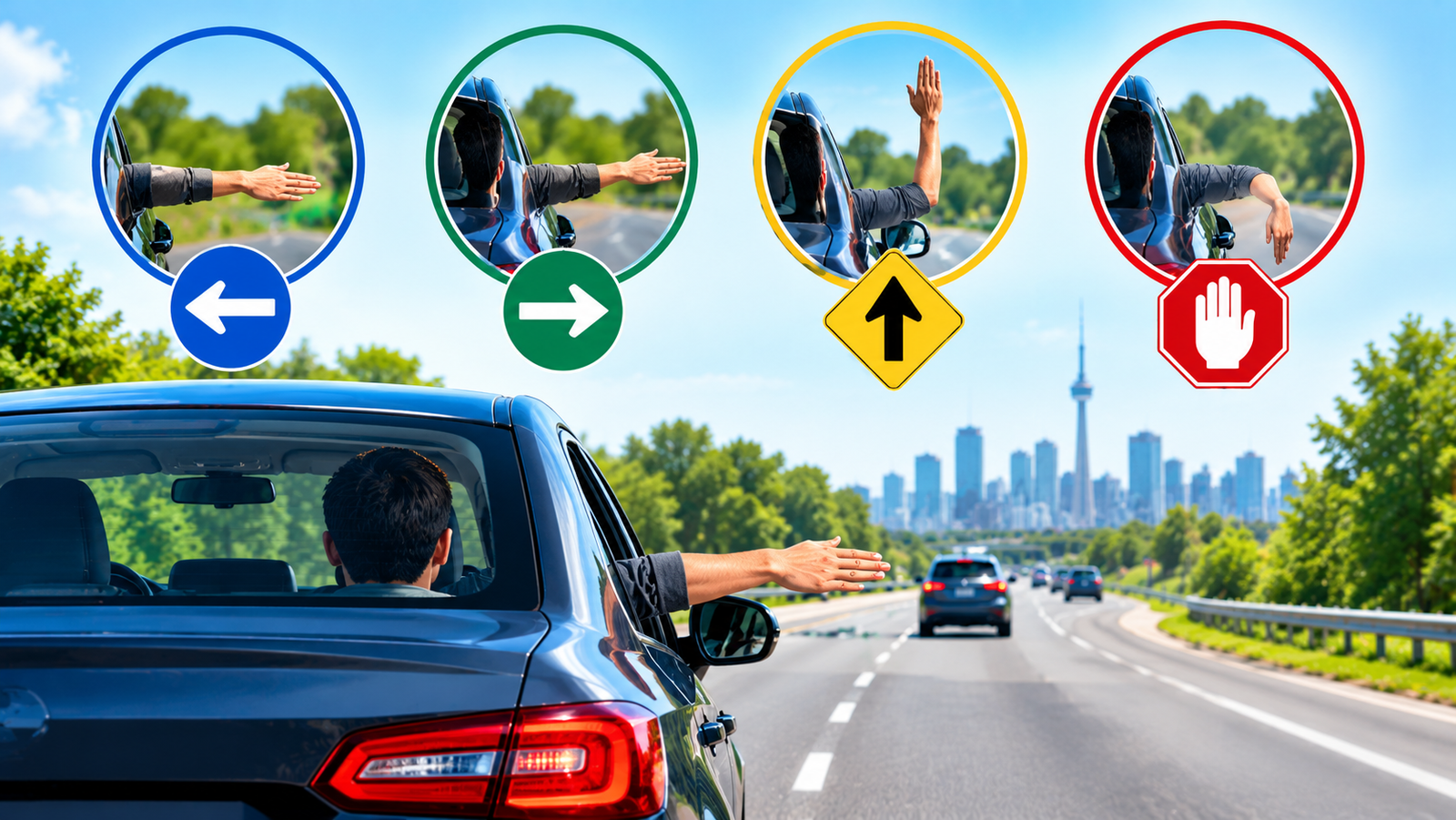
All three signals use your left arm, out the driver’s window.
Left turn
Left arm straight out, level with your shoulder.
Arm points the way you are going
Right turn
Left arm out, bent up at the elbow at a right angle.
Up for right
Slowing or stopping
Left arm out, bent down at the elbow at a right angle.
Down for slow down
Use hand signals when your turn signals and brake lights are not working. Source: Official MTO Driver’s Handbook.
What Are Driving Hand Signals?
Hand signals (also called arm signals) are simple arm positions that tell other road users what you are about to do. They do the same job as your turn signals and brake lights: they warn drivers, cyclists and pedestrians before you turn, change lanes, slow down or stop.
In Ontario, all three driver hand signals are made with the left arm, through the driver’s window, so other road users can see them from the front, the side and behind.
When Do You Need to Use Hand Signals in Ontario?
The handbook is clear: use your turn signals and brake lights to signal before stopping, slowing down, turning, changing lanes, leaving the road or pulling out from a parked position. If your turn signals and brake lights are not working, use hand and arm signals.
So hand signals are your backup system. You may need them if:
- A signal bulb or brake light burns out
- A fuse blows or there is an electrical fault
- You are driving an older vehicle with unreliable lights
Keep in mind that hand signals are harder for others to see than lights, especially at night, in rain or snow. Treat them as a way to get somewhere safely, then get the lights fixed as soon as possible.
What Is the Hand Signal for a Left Turn?
Extend your left arm straight out through the driver’s window, level with your shoulder.
Use it before every left turn and before moving left into another lane. Signal well before you start the turn, and remember that signalling alone does not give you the right-of-way. Check that the way is clear first.
What Is the Hand Signal for a Right Turn?
Put your left arm out and bend it up at the elbow at a right angle, with your hand pointing to the sky.
This is the signal that new drivers most often mix up, because it looks similar to the stopping signal. An easy way to remember it: your arm points up for going right.
What Is the Hand Signal for Slowing Down or Stopping?
Put your left arm out and bend it down at the elbow at a right angle, with your hand pointing toward the road.
Use it before slowing down or stopping, including before a roadside stop. Think of it as pushing down on an invisible brake: arm down means slowing down.
Ontario Hand Signals
| What you are doing | Hand signal (left arm, out the driver’s window) | Memory tip |
| Turning left or moving left | Arm straight out, level with your shoulder | Arm points the way you are going |
| Turning right or moving right | Arm out, bent up at the elbow at a right angle | Up for right |
| Slowing down or stopping | Arm out, bent down at the elbow at a right angle | Down for slow down |
Are Hand Signals on the G1 Knowledge Test?
Hand and arm signals are part of the “Driving along” section of the Official MTO Driver’s Handbook, and the knowledge test is based on that handbook. That means a question about which arm position means what can come up, so they are worth memorizing. Try them in our free G1 practice test before you go to DriveTest.
Do You Use Hand Signals on the G2 Road Test?
On a road test you use your vehicle’s turn signals, because your car must be in good working order to take the test. DriveTest can mark a test as “out-of-order” if the vehicle is not roadworthy, and burnt-out signal or brake lights are the kind of problem that can stop your test before it starts. Check every light a day or two before your appointment — it is on our G2 road test guide for a reason.
Knowing hand signals still helps on test day. Examiners want to see that you understand signalling: signal early, make sure others can see it, check that the way is clear, and cancel the signal after the move.
How Do You Make a Hand Signal Safely?
- Plan ahead. Decide on your turn early so you are not rushing.
- Keep control of the wheel. Steer with your right hand while your left arm is out the window.
- Signal well before the action, and make sure drivers behind you can see your arm.
- Check that the way is clear. Signalling does not give you the right-of-way. Use your mirrors and check your blind spot.
- Bring your arm back in before you start turning, so both hands are on the wheel for the turn.
- Drive more defensively than usual. Other drivers may not notice an arm signal as quickly as a flashing light.
What About Cyclists’ Hand Signals?
Cyclists use hand signals too, and you need to read them. Ontario’s handbook tells drivers to watch for cyclists’ hand signals and notes that a cyclist may signal a right turn by holding their right arm straight out, instead of using the bent-arm signal.
This matters most at intersections and near bike lanes:
- Before turning right across a bike lane, signal, check your mirrors and check your blind spot so you do not cut off a cyclist.
- When turning left, stop and wait for oncoming cyclists to pass.
- Do not follow closely behind a cyclist. Bicycles have no brake lights to warn you when they slow down.
- Try to make eye contact with cyclists when you can.
Why Do Hand Signals Still Matter?
It is easy to think hand signals are old-fashioned. They still matter because:
- Lights fail. A burnt-out bulb can happen on any trip, in any car.
- You share the road with cyclists, who signal with their arms.
- They prove you understand signalling. If you know why each signal exists, you will signal earlier and more clearly with your lights too.
- They are part of the handbook, so they can show up on the knowledge test.
What Are the Most Common Hand Signal Mistakes?
- Mixing up right and stop. Both are bent at a right angle: up means right, down means slowing or stopping.
- Using the right arm. Drivers signal with the left arm, out the driver’s window. Only cyclists use a right-arm signal for turning right.
- Signalling too late, so other drivers have no time to react.
- Assuming the signal gives you the right-of-way. You still have to wait until the way is clear.
- Forgetting to cancel a signal after the turn, which confuses everyone behind you.
Conclusion
Signalling early and clearly is one of the habits examiners notice most. Go Drive Driving School G2 driving lessons in Barrie give you one-on-one, in-car practice on signalling, lane changes, turns and intersections, with feedback after every drive. See our programs and fees or contact us at 705-717-0406.
FAQs
Which arm do you use for driving hand signals?
Your left arm, extended through the driver’s window, for all three signals.
What is the hand signal for stopping?
Left arm out, bent down at the elbow at a right angle, with your hand pointing toward the road.
What is the hand signal for a right turn?
Left arm out, bent up at the elbow at a right angle, with your hand pointing up.
Do I have to use hand signals if my turn signals work?
No. Use your turn signals and brake lights. Hand signals are for when those are not working.
Can I drive with a broken turn signal?
The handbook says to use hand and arm signals if your signals and brake lights are not working, but they are harder to see. Get the lights repaired as soon as you can, and remember your vehicle must be in good working order for a road test.
How do cyclists signal a right turn?
A cyclist may hold their right arm straight out to signal a right turn, so watch for that as well as the bent-arm signal.